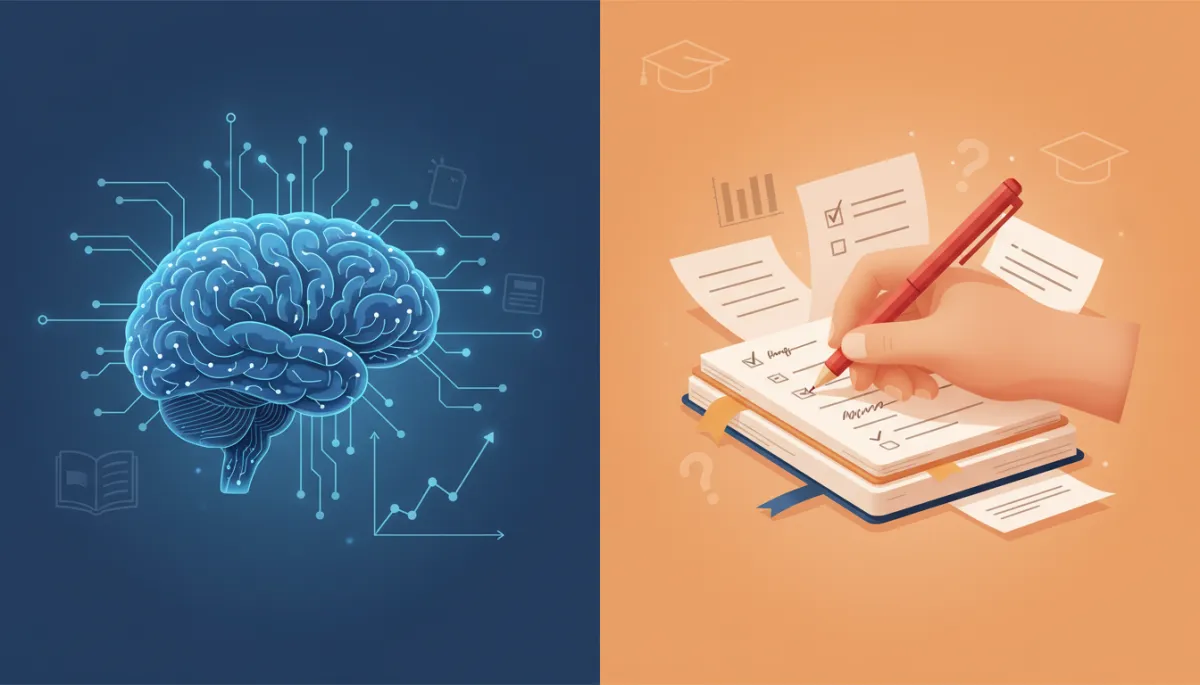
AI vs Human: Grading Essays with ChatGPT
AI Grading, ChatGPT Feedback, Human Teacher Comparison, Education Technology

I Had ChatGPT Grade 50 Essays: Here Is Where AI Beat (and Failed) a Human Teacher
What happens when you ask an AI to mark 50 GCSE-style English essays and compare it with a real teacher? At Step Ahead English Tuition, we decided to find out – not as a gimmick, but to answer real questions about AI Grading, ChatGPT Feedback, and whether Education Technology can genuinely help with teacher burnout without damaging writing integrity.
The Experiment: 50 Essays, One AI, One Human Teacher
At Step Ahead English Tuition, we work with KS3 and KS4 students who need fast, effective support to boost their GCSE English grades. Many of them are juggling mocks, homework and last-minute revision, while their teachers are managing huge marking loads. With AI Grading tools becoming more common, we wanted to test – honestly – how ChatGPT Feedback compares to a human English teacher when marking essays modelled on GCSE exam questions.
We took 50 anonymised essays written in response to typical GCSE-style prompts: language analysis, creative writing and argumentative pieces. A qualified English teacher with GCSE examining experience marked every essay first, using a simplified version of the mark schemes: content and ideas, organisation, vocabulary and sentence control, and technical accuracy. Then we fed the same essays to ChatGPT, asking for:
An overall mark out of 30 (for comparison only, not as an official grade)
Specific feedback on strengths and weaknesses
Two or three clear, practical targets for improvement
Our aim was not to “catch the AI out”, but to see where Education Technology could support real students preparing for GCSEs – and where a human teacher remains absolutely non-negotiable.
Engagement Hook: Can You Spot the AI Grading?
Before we dive into the results, here is a blind sample of feedback on the same short GCSE-style essay. Imagine a student has written a response to the question: “Write a description of a busy train station at the end of a long day.”
Feedback A: Your description uses a range of sensory details, particularly sound, to create a vivid sense of the station. Phrases like “tired footsteps dragging” and “announcements crackling overhead” help the reader picture the scene. To improve, try varying your sentence openings more and experiment with one or two extended metaphors to add originality. Check a few missing commas in longer sentences to keep your writing controlled.
Feedback B: This is a good attempt at description and you clearly understand the task. You have some strong word choices, but you tend to list details rather than develop them, which limits the impact. Think about zooming in on one or two moments – for example, a single commuter or the sound of one train leaving – and showing their emotions. Also, be careful with basic punctuation: there are missing full stops that affect clarity.
One of these is ChatGPT Feedback, and one is from a Human Teacher Comparison. Which do you think is which? Hold your guess – we will reveal the answer later. This simple exercise mirrors what we did with our 50 essays and highlights how close AI Grading can sometimes get to authentic teacher comments, and where subtle differences still matter.
Where ChatGPT Feedback Beat a Human Teacher
Let us start with the positives. When we looked at the 50 scripts, there were several areas where ChatGPT’s AI Grading actually outperformed a tired human marker – especially one with a stack of books and a looming deadline. This is where Education Technology really showed its potential to support, not replace, teachers and tuition providers like Step Ahead English Tuition.
1. Consistency and Stamina
AI does not get bored. It does not mark the first essay generously and the last one harshly because it wants to go home. Across our 50 essays, ChatGPT’s marks were surprisingly consistent. When the quality of writing dipped, the score lowered in a predictable way; when it improved, the score rose. The human teacher was very accurate overall, but we could see tiny fluctuations linked to fatigue – exactly the kind of thing that can contribute to teacher burnout over time.
2. Speed and Volume of Feedback
ChatGPT produced full paragraphs of feedback for each essay in seconds. The comments usually covered structure, vocabulary, coherence and technical accuracy. For a GCSE student revising the night before a mock, that kind of instant response can be incredibly motivating. Instead of waiting days for a teacher to mark a practice essay, they could use AI Grading to get immediate pointers and then bring the improved version to their teacher or tutor for fine-tuning.
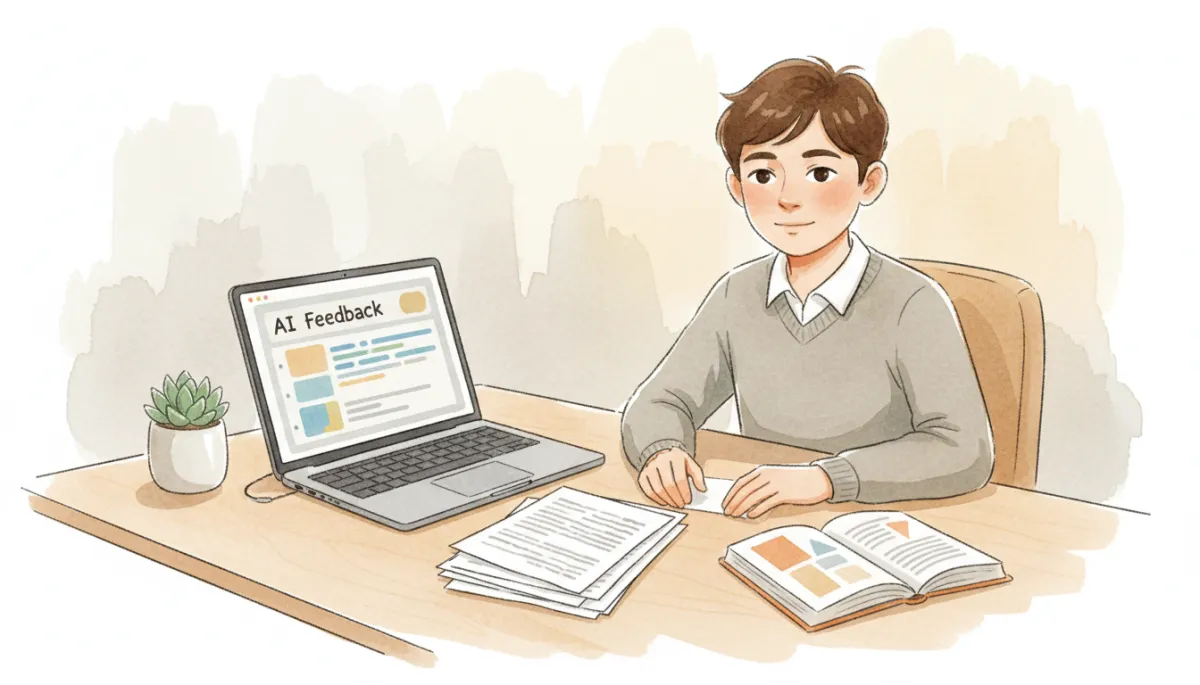
Instant AI feedback can turn last-minute practice essays into powerful revision sessions.
3. Clear, Actionable Targets
One of the strongest aspects of ChatGPT Feedback was its ability to summarise improvement targets clearly. For example, it might say:
“Work on varying your sentence lengths to create more rhythm in your writing.”
“Add more embedded quotations to support your analysis.”
“Check subject–verb agreement and apostrophes for possession.”
These comments align closely with the kind of examiner-approved strategies we use at Step Ahead English Tuition. For students who struggle to understand vague remarks like “develop your ideas more”, AI’s specific and structured phrasing can make the next step feel manageable and motivating.
Where the Human Teacher Still Wins – Clearly
For all its strengths, AI Grading is far from perfect. When we compared ChatGPT Feedback with our Human Teacher Comparison, several important weaknesses appeared – and these matter deeply if we care about writing integrity and genuine learning, not just marks on a page.
1. Understanding the Student Behind the Script
Human teachers carry a mental map of each student’s journey. They know who has English as an additional language, who is dyslexic, who has worked incredibly hard to move from a Grade 3 to a Grade 5, and who is under-achieving because they are not revising. That context shapes feedback. A teacher might say, “This is a big improvement on your last piece – keep using those embedded quotations,” or “You are capable of more precise vocabulary than this; let us push you further.”
ChatGPT, by contrast, treats every essay as if it comes from a blank, anonymous writer. It can recognise patterns in the text, but it cannot genuinely understand the person. For GCSE students, that relationship and encouragement are often the difference between giving up and pushing for the next grade boundary – something central to the ethos at Step Ahead English Tuition.
2. Nuanced Judgement and Mark Scheme Interpretation
GCSE mark schemes are complex. They reward not just correctness, but subtle qualities like ambition, control and “convincing” argument. Our human marker, with examining experience, could weigh up those nuances. ChatGPT could approximate them, but sometimes misjudged how impressive certain features were. It occasionally over-praised formulaic but technically accurate writing, and under-valued genuinely original phrasing that was slightly rough around the edges – exactly the kind of writing that examiners often like.
3. Spotting Authenticity and Writing Integrity
One of the biggest questions around Automated Learning and AI Grading is writing integrity. If students use ChatGPT to write or heavily “polish” their essays, can teachers tell? In our experiment, we deliberately included a few essays that had clearly been “helped” by AI – slightly unnatural phrasing, overly perfect sentence patterns, and a lack of genuine teenage voice. The human teacher picked up on this instantly, noting that the tone felt artificial and not typical of a GCSE student. ChatGPT, however, praised these essays highly, sometimes more than they deserved, because they matched its own style.
📌 Key Takeaway: AI is currently better at rewarding “AI-like” writing than at protecting authentic student voice. Human teachers remain crucial guardians of integrity in English assessment.
Teacher Burnout, Marking Load and the Role of AI
None of this sits in a vacuum. Across the UK, teacher burnout is a serious concern. English teachers in particular often spend evenings and weekends marking essays, planning lessons and writing reports. It is no surprise that Education Technology companies are offering AI Grading tools as a solution: “Let the AI do the marking so teachers can focus on teaching.”
Our experiment suggests a more balanced, realistic picture. AI should not be used to replace professional judgement, especially for high-stakes assessments like GCSEs. However, it can absolutely reduce the burden of low-stakes marking and provide rapid formative feedback. For example:
Students could use ChatGPT Feedback on homework drafts before handing them in, so teachers receive stronger first attempts and spend less time correcting basic issues.
Teachers could use AI to generate quick, personalised targets after mock exams, then refine those targets in class discussions.
Tuition platforms like Step Ahead English Tuition can combine AI-driven practice tasks with human-marked “checkpoint” essays to give students the best of both worlds.
💡 Pro Tip for Students: Treat AI Grading as a practice partner, not a shortcut. Use it to draft, redraft and refine – then ask a teacher or tutor to help you polish your best version.
Automated Learning vs Real Learning: Are You Actually Improving?
Another concern around Education Technology is whether Automated Learning really helps students think more deeply, or simply makes them dependent on tools. Our 50-essay experiment highlighted a crucial distinction: there is a big difference between using AI to generate answers and using it to analyse your own work.
Using AI the Wrong Way: Letting It Write for You
When students copied AI-generated paragraphs directly into their essays, the writing lost authenticity. It sounded polished but generic, and the students themselves could not always explain the language techniques they had “used”. This undermines writing integrity and leaves them unprepared for the real exam, where they must write unaided under timed conditions. No amount of ChatGPT Feedback can compensate for the fact that they have not practised thinking, planning and drafting for themselves.
Using AI the Right Way: A Mirror for Your Writing
However, when students wrote their own essays and then asked ChatGPT for feedback, the picture was very different. Automated Learning became a powerful tool for self-reflection. They could see patterns in their mistakes, receive suggestions for stronger vocabulary, and experiment with restructuring paragraphs. When combined with human guidance from a teacher or from Step Ahead English Tuition, this created a fast, effective cycle of improvement – exactly what last-minute revisers need in the run-up to GCSEs.
The Big Reveal: Which Feedback Was AI, Which Was Human?
Earlier, we asked you to guess which sample feedback was from ChatGPT and which was from a human teacher. Here is the answer:
Feedback A – This was generated by ChatGPT. Notice the balanced structure, the clear praise, and the slightly generic targets about varying sentence openings and adding metaphors.
Feedback B – This came from a human teacher. It focuses more on the student’s tendency to list details and encourages them to “zoom in” on a specific moment – a more narrative, coaching-style comment.
If you guessed correctly, you have a good ear for tone. If not, do not worry – many of our test readers were unsure too. That uncertainty is exactly why we need open, honest conversations about AI Grading and ChatGPT Feedback in schools and tuition settings. The line between AI and human-style comments is blurring, which makes it even more important to use these tools transparently and ethically.
So, Should You Let AI Mark Your GCSE English Essays?
After grading 50 essays with both ChatGPT and a human teacher, our conclusion at Step Ahead English Tuition is clear: AI Grading is a powerful assistant, but a poor replacement. Used wisely, it can:
Give you instant feedback when you are revising alone at home.
Help you spot patterns in your errors and set clear improvement targets.
Reduce some of the marking pressure on teachers, easing teacher burnout and freeing time for higher-quality classroom interactions.
But it cannot:
Truly understand your personal journey, confidence levels or long-term goals.
Judge originality, risk-taking and voice with the same sensitivity as a trained teacher or examiner.
Guarantee writing integrity if you let it write the work for you instead of guiding your own effort.
📌 Key Takeaway: Use AI to practise more, not to care less. The effort you put into each essay still matters more than the tool you use to check it.
How Step Ahead English Tuition Blends AI and Human Expertise
At Step Ahead English Tuition, our mission is to help you boost your GCSE English grades quickly, especially if you feel like you are running out of time. That means using every effective tool available – including AI – but always anchored in expert, human guidance and examiner-approved strategies.
In practice, that could look like this:
You write a timed practice essay using one of our targeted GCSE-style questions.
You run it through AI Grading to get instant ChatGPT Feedback on structure, vocabulary and technical accuracy.
You make a quick redraft based on those comments, focusing on two or three key targets.
You then submit the improved version to a Step Ahead tutor, who marks it using GCSE-style criteria, checks for writing integrity, and gives you personalised next steps and a short study plan.
This blended approach respects the strengths of both AI and human teachers. You get the speed and repetition of Automated Learning, combined with the nuance, encouragement and integrity-checking that only a real person can offer.
Final Thoughts: Stepping Ahead with AI, Not Behind It
AI in education is not going away. Tools that offer AI Grading and ChatGPT Feedback will only become more common in schools, colleges and homes. The real question is not “Should we use AI?” but “How do we use it wisely, fairly and in a way that genuinely helps students grow?”
Our 50-essay experiment showed that AI can match – and sometimes beat – human markers in speed, consistency and clarity of targets. It also revealed clear limits: a lack of personal understanding, difficulty judging originality, and a tendency to reward AI-flavoured writing. For GCSE English students, the safest and most effective path is to treat AI as a revision ally, not as a replacement for your own thinking or your teacher’s expertise.
If you are feeling behind, overwhelmed or unsure where to start with your English revision, you do not have to choose between AI and human support. At Step Ahead English Tuition, we help you harness the best of Education Technology while keeping your learning honest, focused and tailored to you. Together, we can turn those practice essays – whether marked by a teacher, by AI, or by both – into real, rapid progress.
Ready to step ahead?
Start improving today by choosing a personalised revision package with Step Ahead English Tuition and get instant access to fast, proven GCSE English support – with smart use of AI, and real teachers by your side.


