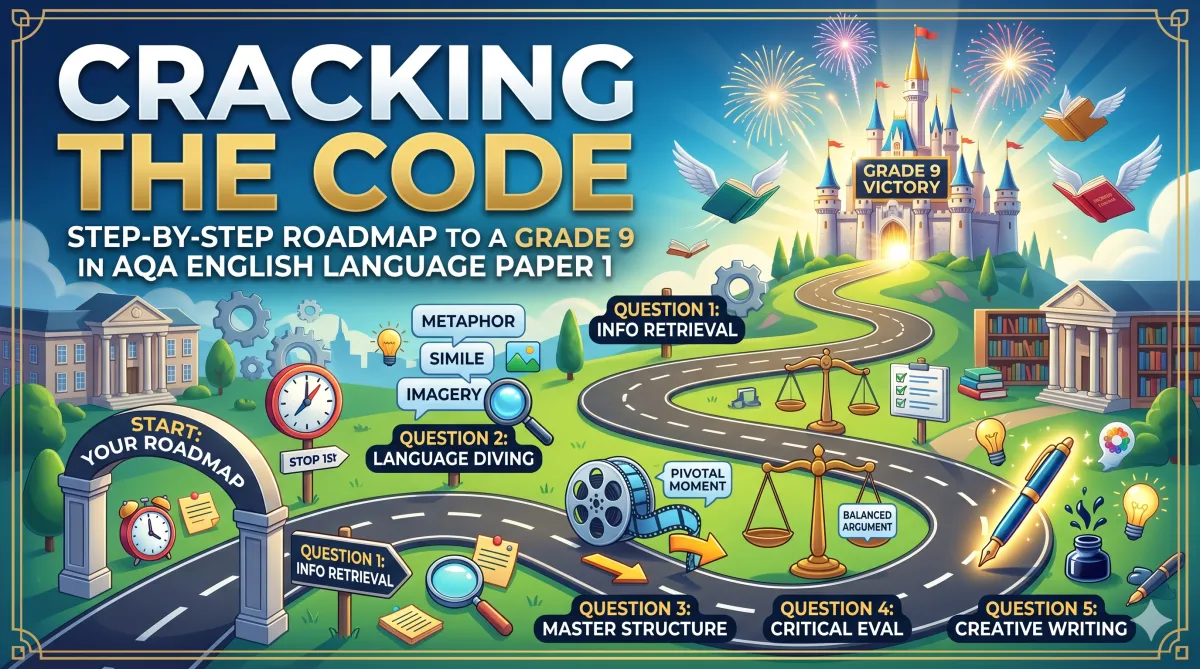
Ultimate Grade 9 Guide: AQA English Language Paper 1 Roadmap

The Step-by-Step Road map to a Grade 9 in AQA English Language Paper 1
The Step-by-Step Road map to a Grade 9 in AQA English Language Paper
The Step-by-Step Road map to a Grade 9 in AQA English Language Paper 1
Question 1: The Quick-Fire Four (4 Marks | 5 Minutes)
Essential Actions: The To-Do List
Common Examiner Rejections: The "To-Avoid" List
Question 2: Diving into Language (8 Marks | 10 Minutes)
Tactical Breakdown: The SQuID/PEED Structure
The Level 4 "Mark-Winning" Example
Question 3: Mastering Structure (8 Marks | 10 Minutes)
Question 4: The Critical Evaluation (20 Marks | 20 Minutes)
The Strategy: Methods Over Meaning
Evaluative Example: Tying Character to Method
Section B / Question 5: Creative Writing Excellence (40 Marks | 45 Minutes)
The Planning Requirement: Non-Negotiable
You must demonstrate assured control. Spend 5 minutes planning:
Advanced Techniques for Grade 9
ONLY £9.99 (More than 50% off now!) with a FREE LIVE MASTERCLASS ON WEDNESDAY AND THURSDAY
CLICK THE IMAGE TO JOIN
Achieving a Grade 9 in AQA English Language Paper 1—Explorations in Creative Reading and Writing—is a feat of clinical precision, not creative luck. As examiners, we are not looking for general summaries; we are looking for a perceptive and detailed engagement with the mechanics of the writer’s craft. This paper is an assessment journey that tests your ability to deconstruct how narrative and descriptive techniques are used to manipulate reader response.
To secure a place in the Level 4 marking tier, you must move beyond clear explanations and into the realm of assured analysis. This guide provides the tactical road map required to navigate the 80-mark challenge with the mindset of a Senior Examiner.
Question 1: The Quick-Fire Four (4 Marks | 5 Minutes)
This is an AO1 "Information Retrieval"task. While it is the lowest tariff question, it is where many high-ability candidates "leak" marks through a lack of discriminate selection.
Essential Actions: The To-Do List
Establish Boundaries:Physically draw a box around the specified lines (e.g., lines 1 to 5). Information outside this box is disregarded.
Judicious Selection:Select four distinct facts that link explicitly to the subject of the question (e.g., "Roland").
Concise Syntax:Keep responses simple. "He was behind a pillar" is more efficient than a complex sentence.
Synthesise Evidence:You may use direct quotes or paraphrases, provided they remain factually accurate.
Common Examiner Rejections: The "To-Avoid" List
Setting Isolation:Do not list details about the setting that do not include the subject.
Reject:"There was a clock over the fireplace."
Accept:"Roland could see a clock over the fireplace."
Inferences:Do not guess feelings. Stick to explicit or implicit facts found in the text.
Line Violations:Mentioning the "September 1986" date is only valid if it appears within the designated lines.
Success Reflection
Ensure every point passes the "Roland Test": if you precede the response with "Roland was..." or "Roland had...", does it remain a factually grounded statement based on the text? This ensures your response is detailed and accurate.
Question 2: Diving into Language (8 Marks | 10 Minutes)
Question 2 assesses AO2, requiring an analysis of how the writer uses language to achieve specific effects. To hit Level 4, you must offer perceptive and alternative interpretations.
Tactical Breakdown: The SQuID/PEED Structure
Statement:Identify a language feature using high-level subject terminology.
Quote:Select judicious textual detail—"zoom in" on a single word or short phrase.
Inference/Inquiry:Explain the primary effect on the reader.
Development:Provide an alternative reading to show layers of meaning.
Essential Terminology
Metaphor, personification, simile, sensory imagery.
Lexical choices:Abstract nouns, emotive verbs, tenacious adjectives.
The Level 4 "Mark-Winning" Example
Example Analysis
The writer employs the metaphor of the book being"bandaged about and about"with dirty white tape. A perceptive reading suggests the book’s fragility; it has been "injured" by years of neglect and mistreatment. However, an alternative interpretation of "bandaged" carries connotations of care and resurrection. It suggests that the book is a "treasured" item that someone has made a concerted effort to "heal" and preserve, despite its state of decay.
Key Instruction
"Say a lot about a little." Do not feature-spot. Instead, analyse how the repetition of "about and about" reinforces the scale of the damage or the intensity of the repair.
Question 3: Mastering Structure (8 Marks | 10 Minutes)
Structure is often misunderstood. It is not just about line breaks; it is about the movement and sequence of the narrative as a whole (AO2).
The Three-Paragraph Formula
The Beginning:Identify the initial focus (e.g., the "peace and calm" of the library environment).
The Shift:Pinpoint the pivotal moment where the pace quickens (e.g., the transition from the "tireless" monotony of research to the discovery of the letter).
The Ending: Analyse the structural closure.
Essential Structural Terms
Shifts in focus, perspective shifts (3rd person omniscient), zooming in/out.
Motif of Time:Note how the text is bookended by chronological markers—the clock at the start and the "clanging bell" at the end.
Cyclical Links:How does the end reflect the beginning?
Success Reflection
A Grade 9 response explains why the writer shifts focus. For example, the Motif of Time creates a sense of urgency. The "clanging bell" at the end provides a structural "closure" that forces Roland into a sudden decision, mirroring his internal shift from an "obedient" researcher to a "rebellious" character.
Question 4: The Critical Evaluation (20 Marks | 20 Minutes)
As the most heavily weighted reading question (AO4), Question 4 requires a convincing and critical response to a given statement.
The Strategy: Methods Over Meaning
You must evaluate the writer’s methods, not just the character’s actions. While you can offer a balanced view, "agreeing to a large extent" allows for the most robust evidence gathering.
Evaluative Vocabulary
"The writer successfully highlights..."
"The use of [method] is highly effective because..."
"This creates a vivid atmosphere which makes the reader..."
Evaluative Example: Tying Character to Method
When evaluating why Roland steals the letters, do not just say he felt like it.
Level 4 Analysis:I completely agree that the theft feels inevitable. The writer uses the metaphor of the"treasure-trove"to place Roland in the position of a treasure hunter. Furthermore, the writer uses the specific verb"seized"to describe his impulse. This choice of language is judicious because it implies the urge is "sudden and uncontrollable," suggesting that the discovery has a powerful, almost supernatural hold over him.
Section B / Question 5: Creative Writing Excellence (40 Marks | 45 Minutes)
This section is worth half the marks on the paper. 24 marks are for Content and Organisation (AO5)and 16 for Technical Accuracy (AO6).
The Planning Requirement: Non-Negotiable
You must demonstrate assured control. Spend 5 minutes planning:
Perspective & Tense:Maintain consistency (e.g., 3rd person, past tense).
The "Structural Blueprint":Plan your pivotal shift and your circular link.
Advanced Techniques for Grade 9
Circular Structure:Ensure your final sentence echoes your opening image for a sense of completion.
Sensory Language:Go beyond sight. What is the smell of the "tenacious" dust? What is the sound of a "clanging bell"?
Varied Paragraphing:Use a one-sentence paragraph to isolate a moment of shock or discovery.
Ambitious Vocabulary & Punctuation:Use colons to introduce lists and semi-colons to balance complex ideas.
Intentional Motif:Choose one object (e.g., a ticking clock or a flickering light) and return to it three times during your piece to show structural control.
Success Reflection: The Holistic Approach
The secret to a Grade 9 is synthesis. Use the techniques you analysed in Section A in your own writing. Use the "Zooming In" technique from Question 2 for your description, and the "Pivotal Shift" you identified in Question 3 to transition your narrative from calm to chaos.
The Final Thought-Provoker
Paper 1 is not a test of your ability to read; it is a test of your ability to see the "invisible strings" the writer uses to pull at the reader. It is an assessment journey that leads from simple retrieval to complex, imaginative creation.
As you approach your final revision, consider this: how does your own"quest for knowledge"and your"tenacious"attention to detail in these weeks mirror the very treasure hunters you are analysing?
Master the code, apply the mark scheme with clinical precision, and the Grade 9 is yours.


