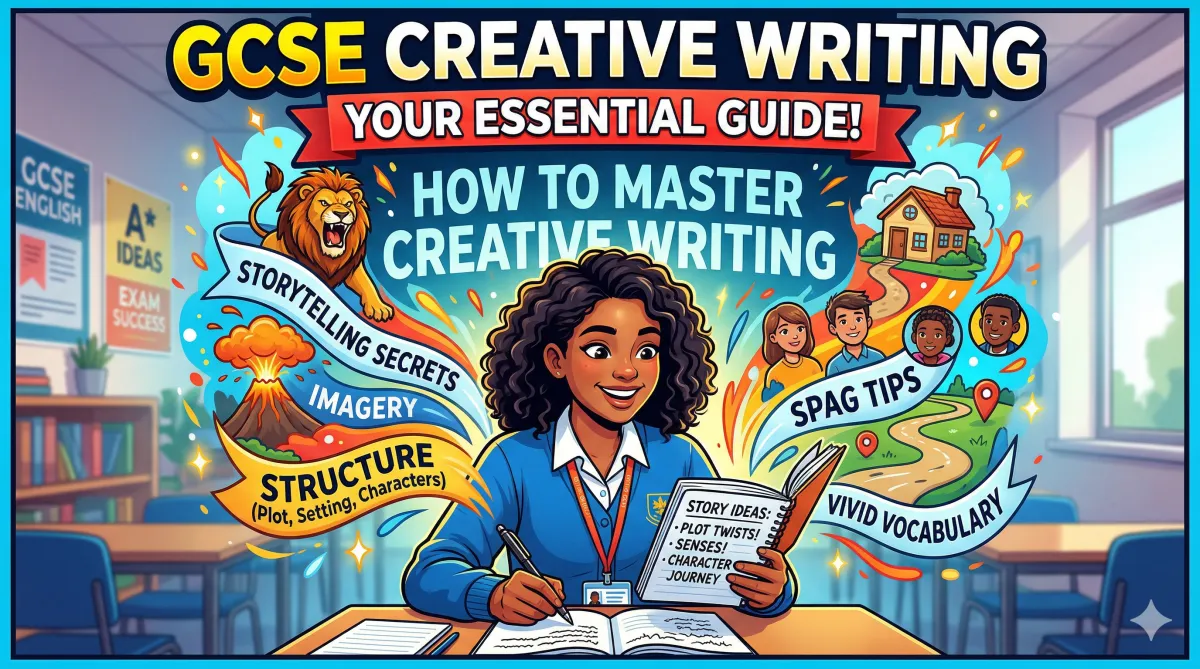
Beyond the Blank Page: 5 Surprising Secrets to Crushing GCSE Creative Writing
Beyond the Blank Page: 5 Surprising Secrets to Crushing GCSE Creative Writing
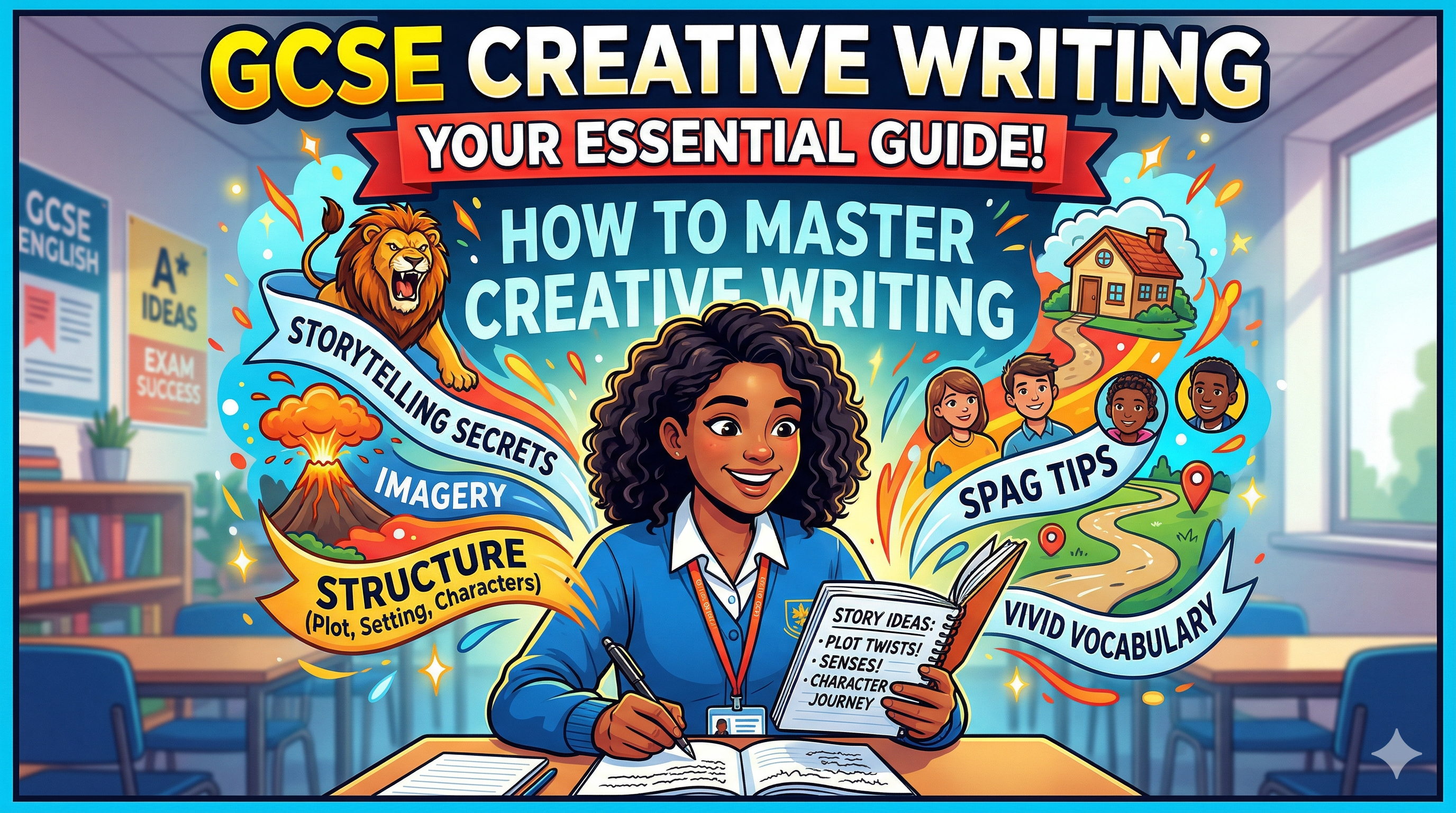
Beyond the Blank Page: 5 Surprising Secrets to Crushing GCSE Creative Writing
Secret #1: Stop Writing "Stories," Start Writing "Openings"
Secret #2: The "Five Gears" of Narrative Movement
Secret #3: Kill the Adjectives, Save the Verbs
Secret #4: The "Box Planning" Hack for Infinite Ideas
Secret #5: "Sensational Sentences" as a Technical Cheat Code
The 45-Minute Panic
It is the moment every GCSE student dreads. You turn the page to Section B: Question 5, and the clock starts ticking. You have 45 minutes to produce a piece of writing worth 40 marks—nearly 25% of your entire English Language grade. For many, this is where the panic sets in. While some students seem to produce effortless, "Grade 9" prose that leaps off the page, others find themselves staring at a blank answer booklet, paralysed by the high-stakes pressure.
Success in creative writing is not down to "natural" talent; it is the result of deliberate crafting. To hit the top marks, you must understand the "Examiner’s Breakdown": 24 marks for AO5 (Content and Organisation) and 16 marks for AO6 (Technical Accuracy). This post distills the most impactful, "insider" strategies used by Lead Practitioners to help you move from a functional pass to a sophisticated Grade 9 performance.
Secret #1: Stop Writing "Stories," Start Writing "Openings"
One of the most significant shifts in the GCSE landscape—specifically for AQA—is the 2026 exam change. Students will no longer be required to write a full story. Instead, the task asks for the "opening" of a story.
Specialist Warning: If you are sitting your exam in November 2025, you are still required to write a whole story with a clear resolution. However, for those moving into 2026 and beyond, focusing purely on the opening is a total game-changer. It allows you to prioritise the exposition—establishing a vivid setting, introducing complex characters, and hinting at a complication. This shift ensures a "well-structured and controlled" piece rather than a rushed, abrupt ending that tanks your AO5 marks.
"Even if you are given a picture prompt, you are still encouraged to write ‘from your imagination.’ This is to encourage students to be more free and creative with their writing, and not feel like they have to describe only what is in the image."
By using the prompt as a springboard rather than a literal checklist, you demonstrate the "ambitious" imagination examiners crave.
Secret #2: The "Five Gears" of Narrative Movement
To secure Level 4 in AO5, your writing must be "sequenced for effect." A common mistake is providing "static" description—random details that don't go anywhere. Instead, visualize your 5-paragraph piece moving through the "gears" of a car to create a Narrative Pyramid:
1st Gear: The Opening (The Panorama). Hook the reader by painting a wide picture of the setting. Use personification to bring the environment to life.
2nd Gear: Zoom In. Focus on a specific detail or the character’s immediate situation. This is your first opportunity for high-level "Show, Don't Tell."
3rd Gear: The Climax. The heart of your piece—the moment of change, a "sharp ringing of a bell," or a shift in tension.
4th Gear: Zoom Out (The Reflective Point). Broaden the perspective. This is a high-level transitional point where you connect the scene to the human condition—the "bigger picture" of loneliness, the passage of time, or the "grind and cares of everyday existence."
Neutral: The Ending. Bring the piece to a resolution. Use a "cyclical link" by referring back to your opening imagery to demonstrate sophisticated structural control.
Need further help with any of the concepts discussed in this blog?
www.stepahead-tutoring.com - Book here
Secret #3: Kill the Adjectives, Save the Verbs
The golden rule for success is "Show, Don't Tell." To force yourself into descriptive excellence, I recommend a strict "to be" verb ban. Avoid was and were entirely. These verbs lead to "telling," which feels shallow to an examiner. Instead, let nouns and verbs do the heavy lifting.
Telling: "It was a spooky house." (Weak adjective, "was" verb).
Showing: "The house had dark windows, shattered lanterns, a doorway covered in cobwebs, and an overgrown path." (Precise nouns force the reader to see the decay).
Telling: "He was a grumpy man."
Showing: "He rarely spoke; instead, he let out a sharp grunt when the neighbourhood children approached his fence."
"Dialogue lines are always showing. That’s because they are reflecting what’s happening in the scene, moment-by-moment; it’s the character talking, not the author."
Secret #4: The "Box Planning" Hack for Infinite Ideas
Grade 9 students don't rush; they engage in "hard thinking graft" before the pen hits the paper. Use the "Box Planning" method: divide your picture stimulus into a 9-box grid and choose 3 to 5 boxes to focus on.
For each box, generate fragments for the five senses, but elevate your vocabulary to catch the examiner's eye. Replace generic words with sophisticated synonyms found in the mark scheme’s "Language Selection" criteria:
Instead of "old," use wizened.
Instead of "loud," use cacophonous.
Instead of "strongly," use tenaciously.
Instead of "the smell of rain," use petrichor (the scent of wet soil).
This precision transforms a "linked, sustained" description into a compelling piece of art.
Secret #5: "Sensational Sentences" as a Technical Cheat Code
Varying sentence structures is a direct requirement for "Technical Control" in AO6. You should have a "cheat sheet" of high-impact linguistic devices ready to deploy to control the reader's pace:
The "More, More, More" sentence: "The more he worried, the more he felt uncomfortable, the more he wanted to leave the room."
The "Short. Short. Long. Long. Short." rhythm: "A scream. A yell. A cry that seemed to shatter the silence of the night. A cry that seemed to echo for miles like a roll of thunder. A bellow."
The "Not, Nor, Nor" structure: "Nobody, not the postman, nor the housekeeper, nor Jim himself knew how the letter had arrived."
The "Sentence, comma, -ing verbs" pattern: "The road unwound, rising, falling, turning, leading him further into the abyss."
These patterns demonstrate a "deliberate crafting" of style that keeps the reader engaged and ensures your technical marks stay in the top tier.
Conclusion: The Mastery Mindset
Quality writing is a matter of habit, not luck. Success in Section B: Question 5 requires a "Slow Writing" mindset—the habit of consciously crafting every sentence rather than writing at a furious, unthinking pace.
Whether you are navigating AQA or Edexcel, the criteria for "compelling fiction" remain universal: engage your reader, sustain a sophisticated style, and use precise language. As you approach your next practice session, ask yourself: How will I use the "Show, Don't Tell" mindset to transform my "to be" verbs into vivid, Grade 9 actions? Turn your 45-minute panic into a masterclass in creative control.


