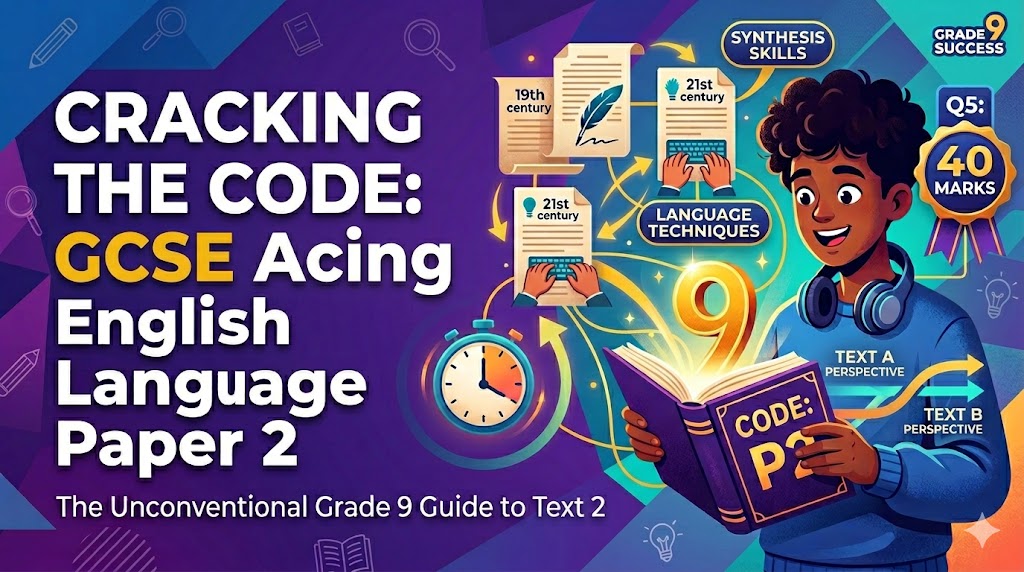
Cracking the Code: The Unconventional Guide to Acing English Language Paper 2

Cracking the Code: The Unconventional Guide to Acing English Language Paper 2
The Unconventional Guide to Acing English Language Paper 2
Cracking the Code: The Unconventional Guide to Acing English Language Paper 2
THE STRATEGY: Flip the Script on Timings
QUESTION 1: The Art of Shading (And Avoiding the "T/F" Trap)
QUESTION 2: Mastery of Inference and Synthesis (8 Marks)
The A-B-C-D Paragraph Structure
Telegraph Phrases for Inferences
QUESTION 3: Language Analysis Beyond Feature-Spotting (12 Marks)
Grade 9 Model Logic: "Black Pyramids" and "Rotten Heart"
QUESTION 4: The Perspective Powerhouse (16 Marks)
The "Half-Mark" Secret
For many students, "Writers' Viewpoints and Perspectives" is the most daunting hurdle in the English Language GCSE. The anxiety often stems from the pressure of analyzing two different texts from two different centuries while managing a ticking clock. However, the secret to success is hidden in the title itself. If you keep the goal—understanding perspectives—at the forefront of your mind, you have already cracked the code. Success depends on recognising what the writers are trying to get across, how their views differ, and how their specific historical contexts shaped those views.
The most counter-intuitive strategy for Paper 2 is to start the exam with the final question. While it feels natural to work from Question 1 through to Question 5, Question 5 alone is worth 40 marks—exactly half of the total marks available for the entire paper. By tackling the writing task first, you ensure your highest-value work is completed while your mind is fresh and your energy levels are at their peak.
NOW ONLY £4 FOR THE COMPLETE REVISION COURSE
CLICK THE IMAGE BELOW
THE STRATEGY: Flip the Script on Timings
Effective time management is the difference between a Grade 5 and a Grade 9. In a 1 hour and 45-minute exam, every second must be accounted for.
Recommended Exam Timings:
Reading: 10 minutes (Read both sources carefully to identify the writer's viewpoint)
Question 5: 35–40 minutes
Question 1: 5 minutes
Question 2: 10–15 minutes
Question 3: 15–20 minutes
Question 4: 20–25 minutes
According to Senior English Lead Mr. Forster, rushing into the questions is a recipe for failure:
"Marking Paper 2 for AQA this year, I found that the biggest issue was that candidates simply had not understood the source texts. Please read them carefully before you do anything else."
The initial 10-minute reading period is non-negotiable. It is the foundation for Grade 9 performance.
QUESTION 1: The Art of Shading (And Avoiding the "T/F" Trap)
Question 1 is a 5-minute task that asks you to identify four true statements. It sounds simple, yet many students lose easy marks here.
Do not write 'T' or 'F' next to the statements. You must shade the circles provided in the box.
RTFQ (Read The Full Question): Ensure you are looking at the specific lines indicated (e.g., lines 1 to 21).
Read the WHOLE sentence: Do not just look at bits of it. Check that you have understood the entire statement properly before shading.
The Dot Method: Place a small dot next to the four statements you believe are true. Re-read the text to confirm before committing to shading.
Scan for Synonyms: The exam board often uses different vocabulary in the statements than what appears in the text. For instance, the text might mention "100 years," while the statement uses the word "century."
QUESTION 2: Mastery of Inference and Synthesis (8 Marks)
Question 2 tests your ability to synthesize. This is the top-level skill of combining ideas and evidence from two different texts. You are expected to write about both sources together within each paragraph.
The Grade 9 Breakdown
To reach the highest marks, you must make inferences. An inference is a conclusion drawn from evidence (e.g., if a writer describes "decaying" tracks, we infer industrial decline). If you make no inferences, your score is capped at 2/8.
The Forbidden Move: Do not state that the difference between the texts is simply that they were written in different time periods. Referring to different time periods is not in itself a valid difference.
The A-B-C-D Paragraph Structure
A: Comparative Topic Sentence: Pick an overall difference that answers the question (e.g., the contrast in size and location).
B: Source A Detail: Use quotations and clear inferences. (Example: In Aberfan, the "decaying" tracks and "disused" canal imply a village in decline.)
C: Connective: Use transition phrases like "By contrast" or "Markedly different from."
D: Source B Detail: Provide points from the second source with inferences. (Example: London is a "colossal city" that is "ceaselessly streaming," implying a hub of industry that stands in stark contrast to the stasis of Aberfan.)
Telegraph Phrases for Inferences
Purpose
Recommended Phrases
Signaling Inference
"From this we can infer..."
Suggesting Meaning
"There is the clear suggestion here that..."
Identifying Implication
"The writer implies here that..."
Connecting Ideas
"The idea of [X] is apparent as [Writer] emphasises..."
Showing Nuance
"This carries the suggestion that..."
QUESTION 3: Language Analysis Beyond Feature-Spotting (12 Marks)
Question 3 focuses on the effects of language. You must pick quotations from the correct part of the text specified in the prompt.
Senior Specialist Advice: Avoid writing about sentence forms unless you are exceptionally confident. Focus on the specific effects of words, similes, and metaphors.
Terminology Toolkit
1. Analysing Words and Phrases
Evocative/Descriptive Phrases: Language that brings strong images to mind.
Verbs:
Stative: Mental actions (e.g., "ponder").
Transitive: Action performed on an object (e.g., "she slapped his face").
Intransitive: Acts by itself (e.g., "I sleep").
Subjunctive: Imagined or desired states.
Semantic Fields: Groups of words related to one topic.
Connotations: Associations (e.g., "black" suggesting negativity).
2. Language Features and Techniques
Figurative Language: Similes, metaphors, and personification.
Sound Techniques:
Alliteration: Sibilance ('s' sounds) or Plosives ('p'/'b' sounds).
Assonance: Repeated vowel sounds.
Consonance: Repeated consonant sounds.
Onomatopoeia: Words like "Bang" or "Clanging."
Grade 9 Model Logic: "Black Pyramids" and "Rotten Heart"
A top-tier answer explains layers of meaning. Describing coal tips as "black pyramids" uses a metaphor for size, but the Grade 9 student notes the symbolism: pyramids are tombs. This ironically implies the coal tips would become a grave for the village children. Similarly, describing a tip as a "killer with a rotten heart" uses an emotive adjective with connotations of malevolence and horror, suggesting the disaster was an act of evil intent.
QUESTION 4: The Perspective Powerhouse (16 Marks)
This is a combination of Question 2 (ideas) and Question 3 (methods). You must compare what the writers think and how they express it.
The "Bottom-Half" Trap: Avoid simple synonyms like "happy," "sad," "positive," or "negative." These place you in the bottom half of the mark scheme. Instead, use sophisticated vocabulary like "depreciating," "cacophony," "stasis," or "ominous."
Examiner’s Warning: Skip the introduction. Go straight into your comparison.
High-Level Response Structure
Topic Sentence: Compare the viewpoints of both writers.
Source A Analysis: Use embedded quotes, zoom in on language, and explain the effect.
Connective: Use a comparative word.
Source B Analysis: Use quotes and explain how the perspective differs.
Example Analysis: "Source A uses a playful juxtaposition, comparing festival-goers to 'survivors of a natural disaster' to mock the writer's own fears. Conversely, Dickens in Source B uses an 'anaphoric catalogue' of onomatopoeic verbs—screams, clanging, bellowings—to build a sense of 'cacophony' that reflects his genuine enjoyment of the fair's chaos."
QUESTION 5: The High-Stakes Persuader (40 Marks)
You must create your own viewpoint. A typical task from Specimen Paper A asks for a speech for a debate at your school or college persuading young people to take more responsibility for protecting the environment from disasters like floods or landslides.
Mark Breakdown:
24 Marks: Content and Organisation (tone, register, and sophisticated sequencing).
16 Marks: Technical Accuracy (punctuation, grammar, and ambitious vocabulary).
Pro-Tip: For a school or college audience, your tone must be persuasive but relatable. Move beyond "sad" outcomes; use "catastrophic" or "irreversible" consequences to build a compelling argument.
The Final Perspective
Mastering this paper is a vital life skill. The ability to analyse two different accounts and understand why the authors see them differently allows you to navigate a world of competing information.
A Final Thought: How might your own context—living in the 21st century—affect how a reader 100 years from now views a text you write today? Understanding the "code" of Paper 2 is your first step in mastering the power of the human perspective.


