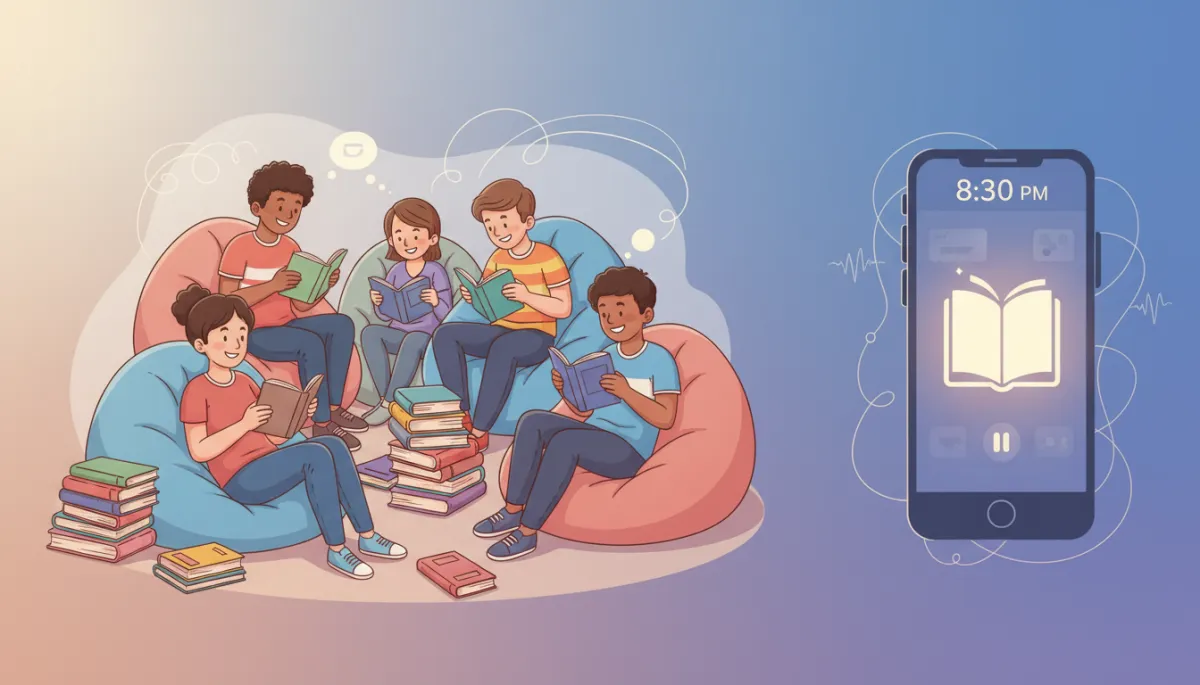
Get Teens to Love Reading Without Pressure
Teen Reading, Reluctant Readers, Literacy Habits

How to Get Teens to Actually Love Reading (Without Forced Reading Logs)
Get Teens to Love Reading Without Pressure
How to Get Teens to Actually Love Reading (Without Forced Reading Logs)
Why Articles Like This Go Viral with Parents and Teachers
The Screen Time and Short Attention Span Problem (Without the Panic)
Why Punitive Reading Logs and Points Backfire
Swap Punishment for Pleasure: Foundations of Genuine Literacy Habits
1. Give Teens Real Choice (Even If It Is Not “Classic” Enough)
2. Make Reading Physically Comfortable and Easy to Start
3. Replace Reading Logs with Real Conversations
Practical, Screen‑Savvy Strategies That Work with Teen Brains
4. Use Screens as a Bridge, Not the Enemy
5. Start with “Snack‑Size” Reading to Beat Short Attention Spans
6. Connect Reading to Real‑World Goals (Including GCSE Success)
Finding “That One Book”: Turning a Reluctant Reader into a Bookworm
Gentle Tracking Without Turning Reading into a Test
How Step Ahead English Tuition Can Support Your Teen’s Reading Journey
Bringing It All Together: A Kinder, More Effective Approach to Teen Reading
If you have ever begged a teenager to finish a chapter, waved a reading log at them, or watched them click away on a screen while a perfectly good book gathers dust, you are not alone. At Step Ahead English Tuition, we hear the same question almost daily: “How do I get my teen to actually enjoy reading, without turning it into a battle?” This guide will show you how to swap pressure and points for genuine Reading Motivation and long‑term Literacy Habits that stick.
Why Articles Like This Go Viral with Parents and Teachers
Posts about Teen Reading tend to explode in group chats and staff rooms because they tap into a shared worry: we know reading is vital, yet so many teenagers seem to be drifting away from books. When someone shares a story about a once‑reluctant reader who suddenly cannot put a book down, it hits a nerve. It offers something we are all desperate for — hope and practical ideas.
Add to that the guilt many adults feel about their own Screen Time Impact, and you have the perfect recipe for a viral post. We are worried about our phones, our teens’ phones, and what all those glowing rectangles are doing to attention spans, empathy, and exam results. Anything that promises to help teenagers rediscover Engaging Books — without another exhausting argument — gets shared, bookmarked, and discussed again and again.
💬 Engagement Hook: What was the single book that turned your reluctant reader into a bookworm? Hold that thought — we will come back to it.
The Screen Time and Short Attention Span Problem (Without the Panic)
Let us be honest: phones, games, and social media are designed to be irresistible. Notifications, streaks, and endless scrolling all train the brain to expect constant novelty. For many teens, a book can feel “too slow” in comparison. This is not because they are lazy or incapable; it is because their brains are being rewarded every few seconds somewhere else. That is the real Screen Time Impact we are dealing with.
Teachers and parents see the effect in the classroom and at home: difficulty settling to longer tasks, skimming instead of reading deeply, and a sense that if something is not instantly entertaining, it is “boring”. When those same teens are then handed a reading log or told they must reach a certain number of Accelerated Reader points to avoid detention, reading stops being a pleasure and becomes a chore. It is like telling someone who is learning to drive that they must complete 500 laps of a car park before they are allowed on a proper road.
⚠️ The Problem with Punitive Logs: When reading is tied to punishment, teens quickly learn that books are something to get through, not something to get lost in.
Why Punitive Reading Logs and Points Backfire
Reading logs and Accelerated Reader points are usually introduced with good intentions. Schools want to track progress, encourage consistency, and reward effort. The problem is that many Reluctant Readers experience these systems as constant judgement. Instead of thinking, “I wonder what happens next in this story?”, they are thinking, “How many pages do I need to tick off tonight?” or “What is the minimum I can read to get my points?”
Research into Reading Motivation shows that when we over‑focus on external rewards — stickers, points, prizes — we can accidentally crush internal motivation. Teens start reading for the reward, not for the story. As soon as the reward disappears, so does the reading. Even worse, teens who read more slowly, who struggle with decoding, or who are still building confidence may feel constantly behind their peers. The very tools meant to help them can end up reinforcing the idea that “reading is not for me”.

Supportive conversations about stories build confidence far more than tick-box reading logs.
Swap Punishment for Pleasure: Foundations of Genuine Literacy Habits
So, what works better? At Step Ahead English Tuition, we focus on three foundations for long‑term Literacy Habits: choice, comfort, and conversation. These are simple shifts, but they transform reading from an obligation into a personal habit your teen actually owns.
1. Give Teens Real Choice (Even If It Is Not “Classic” Enough)
Choice is powerful. If every book your teenager reads is chosen by someone else — a teacher, an exam board, or you — reading will always feel like homework. To build genuine Reading Motivation, they need to feel some control. That might mean:
Letting them pick from a wide range of Engaging Books: graphic novels, football biographies, romance, fantasy, manga, horror, or contemporary YA.
Saying “yes” to re‑reading favourites — comfort reading still counts as reading, and it deepens comprehension.
Allowing them to abandon a book they genuinely dislike and try another, without shaming them.
💡 Pro Tip: Create a “try it” pile with 4–5 different books. Let your teen sample the first chapter of each and choose the one that grabs them. Instant ownership.
2. Make Reading Physically Comfortable and Easy to Start
If reading always happens at a cluttered desk under bright lights, it will feel like work. Instead, help your teen carve out a small, cosy reading zone: a corner of the sofa, a beanbag, a blanket, a warm drink. Keep the book they are reading within easy reach — not buried in a school bag under PE kit and worksheets. The fewer barriers between them and the page, the more likely they are to open the book “just for five minutes”.
Short, predictable routines work wonders here. For example, “ten minutes of quiet reading after dinner” or “a chapter before bed instead of scrolling”. You are not banning screens entirely; you are simply protecting a small window where books get first priority. Over time, these small pockets add up to strong Literacy Habits and deeper focus — skills that pay off brilliantly in GCSE English exams.
3. Replace Reading Logs with Real Conversations
Instead of asking, “How many pages did you read?”, try questions that show you care about the story, not the statistics. Questions like:
“Which character would you most like to be mates with — and why?”
“Did anything surprise you in your book today?”
“If this book was a Netflix series, who would you cast in the main role?”
These questions invite teens to think, imagine, and share their opinions — all crucial for GCSE English — without feeling tested. You are building Reading Motivation by connecting books to their identity, humour, and interests, not to a mark scheme.
Practical, Screen‑Savvy Strategies That Work with Teen Brains
4. Use Screens as a Bridge, Not the Enemy
It is tempting to declare war on screens, but that usually ends in arguments and sneaky scrolling. Instead, use technology to support Teen Reading:
Try e‑books with built‑in dictionaries so your teen can tap on tricky words instead of feeling stuck.
Pair audiobooks with print books: listening while following the text can boost confidence and fluency, especially for Reluctant Readers.
Watch film or series adaptations after reading and compare them — perfect for practising the comparison skills needed in GCSE English.
💡 Pro Tip: If your teen loves gaming, look for books connected to their favourite games or genres — fantasy, dystopian worlds, or sci‑fi adventures often win them over.
5. Start with “Snack‑Size” Reading to Beat Short Attention Spans
If your teen is used to fifteen‑second clips, a three‑hundred‑page novel can look terrifying. Think in “snacks”, not banquets. Short stories, poetry collections, flash fiction, and non‑fiction with clear subheadings all offer satisfying, quick wins. Each completed piece gives a sense of achievement and stretches their attention span a little further.
At Step Ahead English Tuition, we often use short, punchy extracts to hook students in — a dramatic opening paragraph, a tense argument, or a cliff‑hanger scene. Once they are hooked on the moment, it is much easier to tempt them into the whole book. This approach respects their current attention span while gently training it to grow.
6. Connect Reading to Real‑World Goals (Including GCSE Success)
Many teens are practical: they want to know, “What is the point?” Linking reading to their personal goals can boost Reading Motivation. For example:
“Every book you read now makes those long GCSE English extracts feel easier later. You will spend less time decoding and more time picking up marks.”
“If you want to study law, medicine, or game design, you will need to read complex texts quickly and accurately. Reading for pleasure is the best training.”
“Books can improve your writing style, vocabulary, and ideas — all things examiners love.”
The key is to present reading as a powerful tool that helps them get where they want to go, not just another hoop adults make them jump through.
Finding “That One Book”: Turning a Reluctant Reader into a Bookworm
Remember the engagement hook from earlier? “What was the single book that turned your reluctant reader into a bookworm?” Almost every keen reader can name their book — the one that flipped a switch. For some, it was a fantasy epic; for others, a funny school story, a gripping mystery, or a true story that felt painfully real. That first truly Engaging Book is often the gateway to a lifetime of reading.
Your mission is not to make your teen love all books immediately. It is to help them find one book that speaks to them so strongly they forget they are “supposed” to be reading. Here are some ways to track it down:
Ask what they enjoy watching — comedy, crime, anime, rom‑coms, documentaries — and look for books with a similar vibe.
Visit a library or bookshop together and give them a budget or limit — “pick any two books you like”. No comments about reading level or “worthiness”.
Ask friends, older siblings, or teachers which books finally won them over at the same age.
💬 Try This Tonight: At dinner, ask everyone at the table to share “the book that changed everything” for them as a teen. You might be surprised how animated the conversation becomes.
Gentle Tracking Without Turning Reading into a Test
You might still want some way to keep an eye on Teen Reading without sliding back into punitive systems. Here are some low‑pressure alternatives to traditional reading logs and points:
Reading Journals: Encourage your teen to jot down favourite quotes, characters they relate to, or questions a book raises. No marks, just reflections.
Bookshelf Challenges: Use a simple list or small shelf at home to display “books I have finished this year”. Watching the list grow can be motivating.
Star Charts for Habits, Not Pages: If your teen likes visual rewards, give a star for each day they spend any time reading, rather than for hitting page targets.
These approaches keep the focus on consistency and enjoyment rather than comparison or punishment. They also create easy talking points: “I see you have added another book to your shelf — what did you like about that one?”
How Step Ahead English Tuition Can Support Your Teen’s Reading Journey
At Step Ahead English Tuition, we know that strong Literacy Habits are the secret weapon behind rapid progress in GCSE English. Our tutors do not just drill exam questions; we help students discover Engaging Books and extracts that match their interests and ability, then show them how to use those texts to build the skills examiners look for — inference, analysis, comparison, and clear expression.
Because we work with KS3 and KS4 students every day, we see first‑hand how even a small shift in Reading Motivation can transform confidence. A student who once said, “I hate reading” might not transform into a library‑dweller overnight, but they can go from dreading unseen extracts to saying, “I actually understood that one, and I had something to say about it.” That is the moment their grade trajectory starts to change.
📌 Key Takeaway: You do not need to force endless pages or chase Accelerated Reader points. With the right support, your teen can build practical reading skills and exam confidence through texts that genuinely interest them.
Bringing It All Together: A Kinder, More Effective Approach to Teen Reading
If you take one thing away from this article, let it be this: you cannot punish a teenager into loving books. Reading logs, points, and threats might squeeze out a few extra pages in the short term, but they rarely create lifelong readers. Instead, focus on:
Reducing the negative Screen Time Impact by protecting small, regular reading windows.
Offering real choice and comfort so reading feels like a break, not a punishment.
Swapping page‑count questions for genuine conversations about characters, feelings, and ideas.
Helping your teen find that first truly Engaging Book — the one that makes them forget they are “not a reader”.
When you approach Teen Reading with curiosity rather than control, you send a powerful message: “Your thoughts and tastes matter. Books are for you.” That sense of ownership is the real engine behind lasting Literacy Habits — and it is far more effective than any forced reading log.
Ready to Boost Your Teen’s Reading and GCSE English Grades?
If you are feeling stuck, you do not have to figure this out alone. Step Ahead English Tuition specialises in fast, effective support for KS3 and KS4 students, especially those who need a confidence boost before GCSEs. We combine examiner‑approved revision tools with personalised reading recommendations and strategies that respect each student’s pace and personality.
Whether your teen is a complete non‑reader or someone who just needs help stretching from TikTok captions to full‑length texts, we can help them take the next step — and the one after that. Together, we can turn reading from a battleground into a quiet advantage that shows up clearly in their exam results.
✅ Call to Action: Start improving today by choosing a personalised revision package with Step Ahead English Tuition and get instant access to fast, proven GCSE English support — including expert guidance on building reading habits that last.


