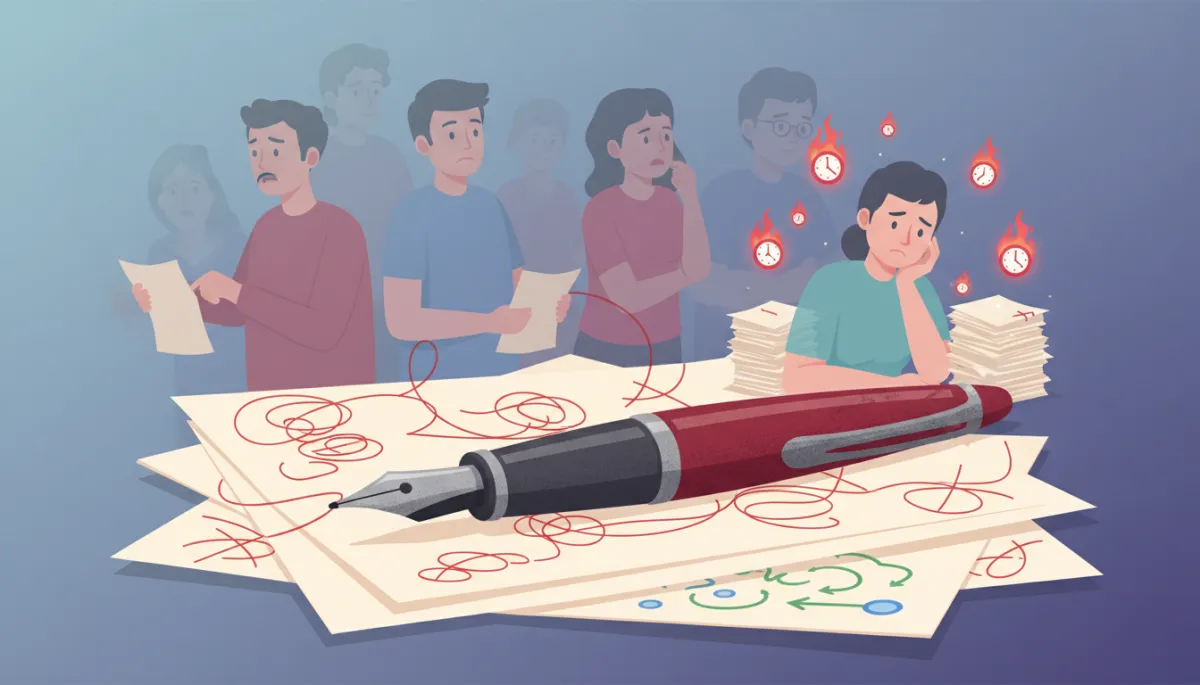
The Red Pen Fallacy: Impact on Student Writers
Education, Student Writing Feedback, Grading Burnout

The “Red Pen” Fallacy: Why Marking Every Single Error Destroys Student Writers
If you still shudder at the memory of an essay coming back smothered in red ink, you’re not alone. The “Red Pen Fallacy” isn’t just a catchy phrase – it’s a powerful way to name something many students and teachers have quietly known for years: relentless line-editing doesn’t build better writers. It breaks their confidence and burns out the very teachers trying to help.
Why the “Red Pen Fallacy” Goes Viral Again and Again
Posts about the Red Pen Fallacy spread like wildfire across teacher forums, TikTok, and education Twitter for one simple reason: almost everyone in education has lived it. Students recognise the sinking feeling of getting a script back that looks as though it’s bled to death. Teachers recognise the Sunday-night despair of another stack of books waiting to be line-edited into oblivion. Parents recognise their child’s face when they say, “I’m just rubbish at English,” after seeing a page full of corrections and crosses.
When we talk about Student Writing Feedback online, the images that go viral are rarely calm, balanced pages. They’re the dramatic ones: paragraphs almost completely overwritten, circles and arrows everywhere, comments squeezed into every margin. These posts strike a nerve because they confirm a suspicion many adults have carried for years – that this level of marking didn’t actually help them learn. It just taught them to dread writing.
💬 Relatable pain point: Viral posts about over-marking aren’t about “lazy students” or “lazy teachers” – they’re about a broken system that equates more ink with more learning.
The Hidden Legacy: How Adults Carry Trauma from Heavily Marked Papers
At Step Ahead English Tuition, we work with KS3 and KS4 students every day – but we also speak with their parents. It’s striking how often adults quietly confess, “I was awful at English at school,” or, “My teacher ripped my essays to shreds; I still hate writing.” These are echoes of what we might call Teacher Trauma from the learner’s side: emotional scars left by well-meant but overwhelming feedback.
Research into feedback and motivation backs this up. Studies in educational psychology consistently show that when feedback is experienced as threatening rather than supportive, students’ sense of competence drops. One well-known meta-analysis by John Hattie found that feedback can be one of the most powerful influences on achievement – but only when it is focused, manageable, and linked to clear goals. Overly detailed, error-by-error commentary can have the opposite effect, especially for less confident writers.
For many adults, the memory of a red-inked essay is not just about a grade. It’s about shame. It’s about reading comment after comment that essentially says, “Wrong, wrong, wrong,” without ever clearly saying, “Here’s what you did well,” or, “Here is the one thing to improve next time.” That experience can calcify into a fixed belief: I can’t write. And when those adults later support their children, that belief quietly shapes the messages they pass on about English, essays, and exams.
💡 Key insight: The Red Pen Fallacy doesn’t just damage one draft. It can damage a student’s writing identity for years – sometimes for life.
When Helping Hurts: Grading Burnout and the Cost to Teachers
Of course, the Red Pen Fallacy isn’t only harmful for students. It quietly grinds teachers down as well. Many English teachers feel a deep moral duty to give thorough feedback. They’ve been told – explicitly or implicitly – that a “good” teacher marks everything. Every sentence, every comma splice, every awkward phrase. Anything less can feel like letting students down, or leaving yourself open to criticism from leadership, parents, or exam results data.
The result? Grading Burnout. Hours spent line-editing 30 essays after a full teaching day. Weekends swallowed by a pile of mock papers. Late nights where your own family barely sees you because you’re still circling adverbs and rephrasing topic sentences. This isn’t a sign of teacher weakness; it’s a predictable outcome of a culture that equates quantity of marking with quality of teaching.
Research on teacher workload and wellbeing repeatedly highlights marking as one of the most stressful, time-consuming tasks. The Department for Education’s workload reviews have pointed to excessive written marking as a major driver of stress and attrition. When teachers are expected to provide exhaustive Student Writing Feedback on every draft, they pay a price in sleep, health, and job satisfaction. Over time, that exhaustion can harden into cynicism: “They don’t read it anyway,” or, “Nothing changes, no matter how much I write.”

Excessive line-editing drains teacher energy long before it boosts student progress.
At Step Ahead English Tuition, we often support students whose teachers are clearly working incredibly hard. The problem isn’t a lack of effort; it’s that effort is being poured into a feedback style that research shows is inefficient and, in some cases, counterproductive. It’s no wonder so many teachers feel they’re sprinting on the spot.
Why Marking Every Single Error Doesn’t Work (Even When It’s Done with Love)
The heart of the Red Pen Fallacy is this belief: If I correct everything, they’ll learn everything. It feels logical. See an error, fix an error, prevent it in future. But learning to write isn’t like fixing a broken bike chain. It’s more like learning to ride in the first place – you need balance, confidence, and practice, not a running commentary on every wobble of the handlebars.
Cognitive load theory helps explain why relentless line-editing fails. Students can only process a limited amount of new information at once. When a draft comes back with twenty, thirty, or fifty separate points to “fix”, most learners can’t meaningfully act on them. Instead, they skim, feel overwhelmed, and often default to surface-level corrections: swapping a word here, adding a comma there, without really understanding the deeper skills they’re meant to be developing, such as argument, structure, or analysis of language and form – all vital for GCSE success.
There’s also the emotional load. Feedback that focuses almost entirely on what’s wrong sends a clear, if unintentional, message: Your writing is mostly a problem to be fixed. For students already anxious about English, this can make them risk-averse. They write less. They play it safe. They stop experimenting with ambitious vocabulary or complex sentences – exactly the things examiners reward when they’re done well. In trying to “perfect” every line, we accidentally shut down the very creativity and resilience that strong writing requires.
📌 Key takeaway: Marking more is not the same as teaching more. Effective Feedback Strategies focus on what students can actually use, not on everything they did “wrong”.
A Research-Backed, Sanity-Saving Alternative to Relentless Line-Editing
So if the Red Pen Fallacy doesn’t work, what does? The good news is that there are Line-editing Alternatives which are both evidence-informed and humane – for students and teachers alike. At Step Ahead English Tuition, our approach to writing feedback is built around three core principles, strongly supported by research:
Less is more: Focus on one or two high-leverage targets per draft.
Feedback belongs to the learner: Involve students in noticing, choosing, and acting on feedback.
Progress over perfection: Track small, visible gains rather than chasing flawless scripts.
1. Targeted Feedback: One Draft, One Main Focus
Instead of trying to fix everything at once, research suggests we should zoom in. For example, you might decide that on this draft, your priority is paragraph structure or using evidence effectively, not every spelling slip. That doesn’t mean you ignore glaring errors forever; it means you sequence your feedback so that students can actually act on it. Hattie and Timperley’s work on feedback emphasises clarity of purpose: students need to know where they are going, how they are going, and where to next. A single, clear focus makes this possible.
In practice, that might look like a short success checklist stuck into books, or a simple code: “This time, I’m only marking for clarity of argument.” The rest can wait. Over the term, you can rotate priorities so that key GCSE skills – such as thesis statements, analysis, and technical accuracy – all receive attention, but never all at once. Students see themselves improving step by step, and teachers see their marking load become more realistic.
2. Move from “Doing Feedback To” Students to “Doing Feedback With” Them
Another powerful alternative to heavy line-editing is to share the cognitive load with students. Instead of writing ten separate comments about vague analysis, you might highlight three sections and ask, “Which of these is your strongest analysis, and why?” or, “Underline one sentence in each paragraph that you think could be more precise.” This kind of guided self-assessment turns feedback from a one-way verdict into a conversation, and it builds metacognition – the ability to think about one’s own thinking – which is strongly linked to exam success.
Peer feedback, when carefully structured, can also reduce teacher workload and improve learning. Simple routines like “two stars and a wish” (two strengths, one target) or colour-coding topic sentences can help students see patterns in their writing without you personally correcting every line. The key is to keep tasks specific: “Highlight where they’ve zoomed in on a key word in the quote,” rather than, “Improve this paragraph.”
3. Upgrade Whole-Class Feedback and Modelling
Instead of writing the same comment thirty times, whole-class feedback allows you to address common issues once, powerfully. After a set of essays, you might create a short slide or handout with:
What went well: three real student examples of strong introductions or insightful quotations.
Even better if: one or two shared targets, such as “link back to the question at the end of each paragraph”.
Try this next time: a model paragraph or sentence starter students can adapt in their next piece of writing.
This approach is strongly aligned with effective Effective Feedback Strategies highlighted in research: it’s timely, specific, and forward-looking. It also dramatically reduces marking time while preserving – and often improving – impact. At Step Ahead English Tuition, we use whole-task modelling constantly: annotating model answers, comparing two responses, and asking students to “upgrade” a weak paragraph together. They learn more from seeing and improving a few clear examples than from scanning pages of corrections on their own work.
4. Short, Actionable “Next Steps” Instead of Endless Marginalia
Perhaps the simplest shift away from the Red Pen Fallacy is to replace a forest of margin notes with a single, clear “next step” at the end of the work. For example:
“Next step: In your next essay, aim to use at least three embedded quotations and explain one key word in each.”
“Next step: Focus on topic sentences – start each paragraph by clearly answering the question in your own words.”
Students can then be given five or ten minutes in the next lesson to act on that one step – perhaps by redrafting a paragraph or writing a fresh one from a similar question. This closes the feedback loop and makes sure your effort actually turns into learning, not just more ink on paper.
What This Looks Like for GCSE English Students
For KS3 and KS4 students, especially those approaching GCSEs, moving away from the Red Pen Fallacy can be transformative. Instead of seeing English as a subject where they’re constantly “wrong”, they begin to see it as a skill they can grow quickly with the right focus. At Step Ahead English Tuition, a typical writing journey might look like this:
Diagnostic piece: a short timed response to identify current strengths and gaps.
One main target: for example, “zooming in on language” or “organising ideas clearly”.
Model and practise: looking at strong examples, then practising that one skill in short bursts.
Short, specific feedback: one or two comments, plus a clear next step.
Visible progress: comparing “before and after” paragraphs so students can see how far they’ve come.
This kind of focused approach often leads to rapid gains in exam-style writing – sometimes in a matter of hours, not weeks – precisely because it avoids overwhelming students. Instead of drowning in corrections, they’re given a small number of high-impact tools and shown how to use them confidently.
A Question for Teachers: How Much Feedback Is “Too Much”?
If you’re a teacher reading this, you’ve probably wrestled with these tensions yourself. You care deeply about your students’ writing. You want them to succeed in their GCSEs and beyond. But you also know that your current marking habits may not be sustainable – or even particularly effective. So here’s a genuine invitation:
❓ What is your personal rule of thumb for how much feedback is “too much” feedback on a draft?
Do you have a limit – three comments per page, one main target per piece, ten minutes of marking per script? Have you found a particular Line-editing Alternative that has freed you from Grading Burnout while still moving your students forward? Your experiences matter, because they help challenge the myth that good teaching always looks like a page soaked in red ink.
Moving Beyond the Red Pen: A Healthier Future for Students and Teachers
The Red Pen Fallacy is powerful precisely because it’s so familiar. But familiarity doesn’t make it effective. When we keep clinging to relentless line-editing, we risk creating a cycle of Teacher Trauma, Grading Burnout, and students who grow up believing they “just can’t write”. It doesn’t have to be this way. By embracing more focused, research-backed Effective Feedback Strategies, we can protect teacher wellbeing and build student confidence at the same time.
At Step Ahead English Tuition, our mission is to help GCSE English students make rapid, meaningful progress – without the emotional baggage that so many adults still carry from their school days. That means feedback that is clear but kind, challenging but achievable, and always aimed at the next small step forward rather than a mythical perfect script. When students see that improvement is possible in a short space of time, their motivation soars. When teachers see that their marking is finally translating into visible gains, their energy and sense of purpose return.
🌱 Encouragement: You don’t have to fix every error to change a student’s writing life. Sometimes, the bravest choice is to put down the red pen and pick up a simpler, smarter feedback plan instead.
Ready to Step Away from the Red Pen?
If you’re a parent or student who recognises the damage of the Red Pen Fallacy – or a teacher looking for practical ways to support your learners without burning out – Step Ahead English Tuition is here to help. Our examiner-approved resources, model answers, and personalised study plans are designed to give students exactly what they need to improve their writing fast, without overwhelming them with endless corrections. We focus on the few changes that make the biggest difference in the exam room, and we show students how to apply them with confidence under timed conditions.
Whether your child needs last-minute revision support or a longer-term boost in English, we can help them turn anxiety into achievement – and help you step away from the belief that more red ink is always the answer. Together, we can build a generation of writers who don’t flinch at feedback, but see it as a powerful tool they know how to use.
Start improving today by choosing a personalised revision package and get instant access to fast, proven GCSE English support. Let’s leave the Red Pen Fallacy behind – and step ahead towards feedback that truly works for everyone.


