GCSE English Revision Tips, Exam Guides & Tutoring Blog | Step Ahead
Explore expert GCSE English advice, Grade 9 revision guides, and exam strategies for AQA and other boards. Boost your English Literature and Language grades today.
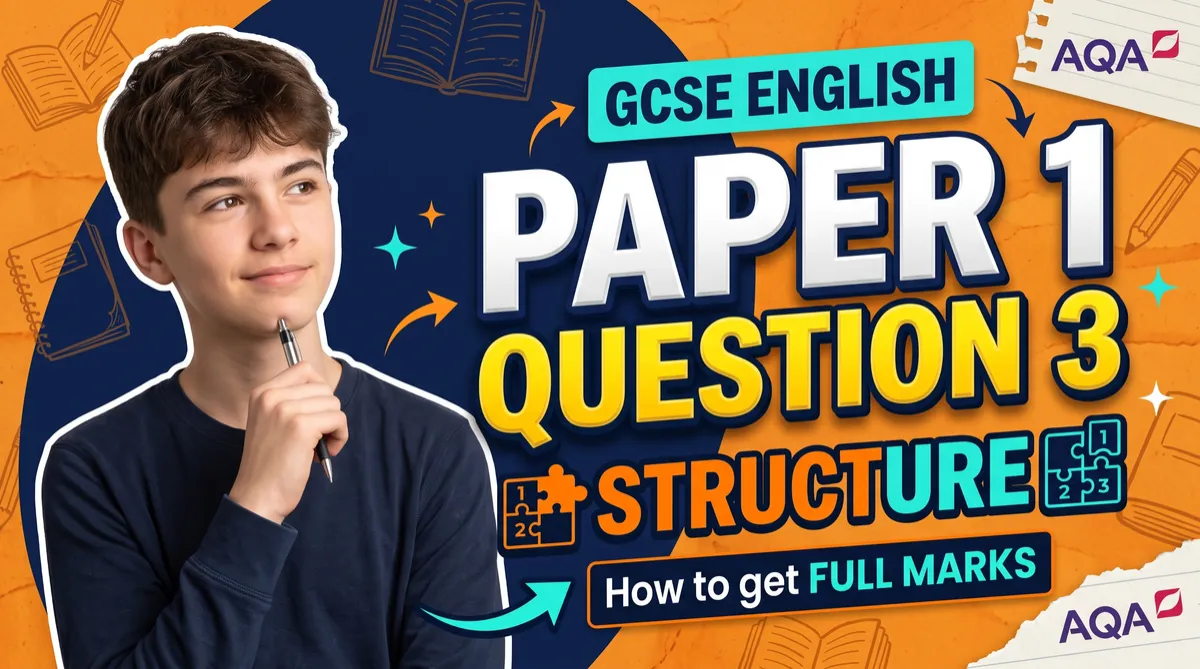
AQA English Language Paper 1 Question 3: How to Write About Structure Before Your Mocks

Of all the questions on AQA English Language Paper 1, Question 3 is the one that makes students freeze. They can spot a metaphor in their sleep, but ask them how a text is structured and the answer often turns into a second go at language analysis. The good news? Structure is one of the most teachable skills on the paper. With a simple method and a handful of precise terms, it can become a reliable eight marks in your mocks.
What Question 3 actually asks
Question 3 is worth 8 marks and asks you to think about the whole source, not just one section. The question usually reminds you where the extract comes from (for example, the opening of a novel) and then asks how the writer has structured the text to interest you as a reader. You are normally given prompts about what the writer focuses your attention on at the beginning, how and why that focus changes as the source develops, and any other structural features that interest you.
Most teachers advise spending around 8 to 10 minutes on it. That is enough time for three focused paragraphs, and no more.
Structure vs language: the difference that costs marks
Language is about word-level choices: verbs, adjectives, imagery, sentence forms. Structure is about the order and organisation of the whole text: where we start, where the camera moves, what is held back, and where we end up.
A quick test: if your point would still make sense after you swapped every word for a synonym, it is probably structural. "The writer moves from the inside of the house to the street outside" is structure. "The verb 'crept' suggests fear" is language, and it belongs in Question 2.
The three-move method: beginning, shift, ending
Think of the writer as a film director holding a camera. Your job is to track where the camera points and explain why.
Beginning: What are we shown first? A setting, a character, a tiny detail, a piece of dialogue? Why might the writer open there? (To intrigue us, to set a mood, to introduce a character before the action.)
Shift: Where does the focus move in the middle, and why at that moment? Look for changes in place, time, perspective or pace.
Ending: Where are we left? Does the extract end on a cliffhanger, a return to the opening image, or a sudden revelation? What effect does that have on the reader?
Writing one paragraph for each move gives your answer a natural, chronological shape, which is exactly what examiners like to see.
[ADD IMAGE HERE: in-post graphic from the draft doc – delete this line]
Structural features worth naming
Precise terms help, but only when you explain their effect. These are the ones that come up again and again:
Shift in focus: moving from one character, object or place to another.
Zooming in or out: from a wide view to a small detail, or the reverse.
Flashback or time shift: jumping backwards or forwards in time.
Change in perspective: a switch in whose viewpoint we follow.
Withholding information: delaying a reveal to build mystery.
Contrast or juxtaposition: placing two very different moments side by side.
One-line paragraph: isolating a moment to give it weight.
Cyclical structure: ending where we began, often with a change in meaning.
A model paragraph
Imagine an extract that opens with an elderly woman threading a needle by her window, then widens to show the flooded village street outside, flashes back to the day the river first rose, and ends with a knock at the door. Here is a model paragraph on the first two moves:
At the start, the writer narrows our focus to a single, quiet detail: the woman's hands threading a needle by the window. This close-up creates a calm, almost frozen moment, which makes the reader curious about who she is and why she is so still. The writer then shifts the focus outwards to the flooded street beyond the glass. This sudden widening reveals that her calm is surrounded by chaos, creating tension as we realise the danger she seems to be ignoring. The structure therefore moves from stillness to threat, making us question whether her calm is courage or denial.
Notice what it does well. It tracks the text in order, uses structural language ("narrows our focus", "shifts the focus outwards"), and keeps returning to the effect on the reader. It barely mentions individual words at all.
Common mistakes to avoid in your mocks
Writing about language: If you are analysing a single adjective, stop and zoom out.
Feature spotting: "There is a flashback" earns little on its own. Always add why it is placed there.
Ignoring the ending: Many students run out of time after the opening. The final lines often carry the strongest effect.
Over-quoting: Short references are enough. You are tracking movement, not dissecting phrases.
Retelling the story: Every sentence of summary should be followed by an explanation of its effect.
If you are sitting Edexcel, OCR or Eduqas, these skills still help whenever you are asked how a writer has organised a text.
Key takeaways
Question 3 is about the whole text: its order, focus and movement.
Use the three-move method: beginning, shift, ending.
Name the structural feature, then explain why the writer placed it there.
Keep quotations short and avoid word-level language analysis.
Aim for around 8 to 10 minutes and three focused paragraphs.
Structure clicks fastest with practice and feedback on your own answers.
If you or your child would like support getting mock-ready, book a free GCSE consultation and we can talk through where the marks are being lost and how to win them back.


Empowering students across the United Kingdom to reach their potential

Links
Legal
Newsletter
Join our community to stay updated on the latest courses, exclusive content, and learning resources. Subscribe now and take the next step in your educational journey!


© Copyright 2025. Step Ahead Tuition. All Rights Reserved. Powered by Lead Core.