GCSE English Revision Tips, Exam Guides & Tutoring Blog | Step Ahead
Explore expert GCSE English advice, Grade 9 revision guides, and exam strategies for AQA and other boards. Boost your English Literature and Language grades today.
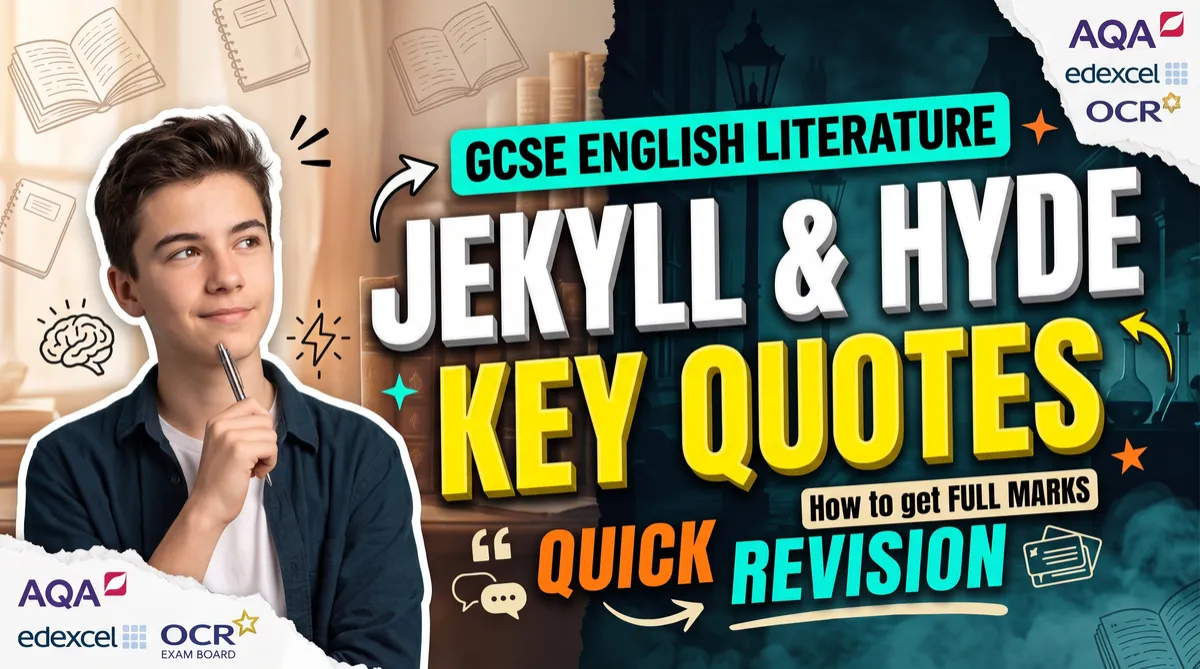
Jekyll and Hyde Key Quotes: 8 Must-Know Quotes for Your GCSE Mocks
With mocks only weeks away, many Year 11 students open their copy of Jekyll and Hyde and feel overwhelmed. It is a short novella, but it is packed with memorable lines, and it is hard to know which ones are worth learning. The good news is that you do not need fifty quotations. You need a small set of flexible ones that you understand deeply and can use for almost any question.
In this guide, I have picked eight key quotes from Robert Louis Stevenson's novella, grouped them by theme, and shown you exactly how to turn one into a top-band paragraph.
Why a few flexible quotes beat a long list
Jekyll and Hyde appears on the 19th-century novel lists for several GCSE exam boards. On AQA, for example, you start with an extract and then write about the novel as a whole, so you need quotes from across the book, not just the passage in front of you.
Examiners reward analysis, not memory. A short quote that you can unpick word by word (two to five words is ideal) is worth far more than a long sentence you can only copy out. Each quote below works for at least two themes, so you can adapt it on the day.
Hyde as a monster: quotes on violence and evil
"like some damned Juggernaut" (Chapter 1, Story of the Door). Enfield describes Hyde trampling a young girl. A juggernaut is an unstoppable force that crushes anything in its path, which suggests Hyde's violence is mechanical and without conscience.
"really like Satan" (Chapter 1). Enfield again, describing Hyde's "black sneering coolness". The religious comparison makes Hyde a figure of pure evil from the very first chapter.
"pale and dwarfish" (Chapter 2, Search for Mr. Hyde). The narrator notes that Hyde gives "an impression of deformity" that nobody can quite name. His small size can hint that he is the less developed side of Jekyll.
"Something troglodytic" (Chapter 2). Utterson searches for a word for Hyde and lands on a cave-dweller. This links to Victorian fears, sharpened by Darwin's ideas, that humans could slide backwards into a primitive state.
"ape-like fury" (Chapter 4, The Carew Murder Case). Hyde beats Sir Danvers Carew to death. The animal imagery continues, and the victim's "high position" makes the crime an attack on respectable society itself.
Duality and secrecy: quotes on Jekyll and Victorian society
"man is not truly one, but truly two" (Chapter 10, Henry Jekyll's Full Statement of the Case). This is the heart of the novella's theme of duality. The repetition of "truly" makes Jekyll's discovery sound like a scientific law rather than a personal excuse.
"pure evil" (Chapter 10). Jekyll claims that Hyde "alone in the ranks of mankind, was pure evil". Notice what he leaves out: Jekyll himself remains mixed, so he can blame his worst desires on someone else.
"the style of the day of judgment" (Chapter 1). Enfield refuses to ask questions because doing so feels like passing judgement. This is a brilliant quote for secrecy and reputation: Victorian gentlemen would rather look away than risk a scandal.
Turning a quote into a top-band paragraph
Here is a model paragraph I have written using quote 5. Look at how it zooms in on single words, links to context, and keeps returning to Stevenson's purpose.
Stevenson presents Hyde as a figure who could drag civilised society backwards. When he attacks Sir Danvers Carew "with ape-like fury", the compound adjective "ape-like" ties him to an animal ancestor rather than to a gentleman. For readers in 1886, less than thirty years after Darwin's On the Origin of Species, this might have stirred fears of degeneration: the idea that humans could slip back down the evolutionary ladder. The noun "fury" suggests emotion without any restraint, the very opposite of the self-control expected of a respectable Victorian man. Crucially, the beast is not lurking in a distant slum; it lives inside one of London's most respected doctors. Stevenson therefore implies that the real danger is the darkness that respectable society hides within itself.
Notice the structure: a clear point about Stevenson's methods, an embedded quote, close analysis of individual words, relevant context, and a final sentence that zooms out to the writer's message.
Three mistakes to avoid in your mock
Treating Hyde as a separate person. Strong answers remember that Hyde is Jekyll. Every quote about Hyde is also a comment on Jekyll's hidden self.
Bolting on context. Avoid a paragraph of history at the end. Link context to a specific word, as the model does with "ape-like".
Ignoring the narrators. Much of the novella is filtered through Utterson and Enfield, men who value reputation. Mentioning who is speaking adds an extra layer to your analysis.
Key takeaways
Learn eight short, flexible quotes rather than a long list you cannot analyse.
Group them by theme: Hyde's violence and evil, duality, and secrecy and reputation.
Know the chapter each quote comes from so you can track how Stevenson builds the mystery.
Zoom in on single words such as "ape-like", "troglodytic" and "truly".
Weave context into your analysis instead of adding it at the end.
If your child would like personal support getting ready for their English Literature mocks, I would be happy to help. Small group and 1:1 lessons run online on Google Meet, matched to your exam board.
Book a free GCSE consultation and we can talk through where they are now and what would help most.


Empowering students across the United Kingdom to reach their potential
Links
Legal
Newsletter
Join our community to stay updated on the latest courses, exclusive content, and learning resources. Subscribe now and take the next step in your educational journey!


© Copyright 2025. Step Ahead Tuition. All Rights Reserved. Powered by Lead Core.