GCSE English Revision Tips, Exam Guides & Tutoring Blog | Step Ahead
Explore expert GCSE English advice, Grade 9 revision guides, and exam strategies for AQA and other boards. Boost your English Literature and Language grades today.
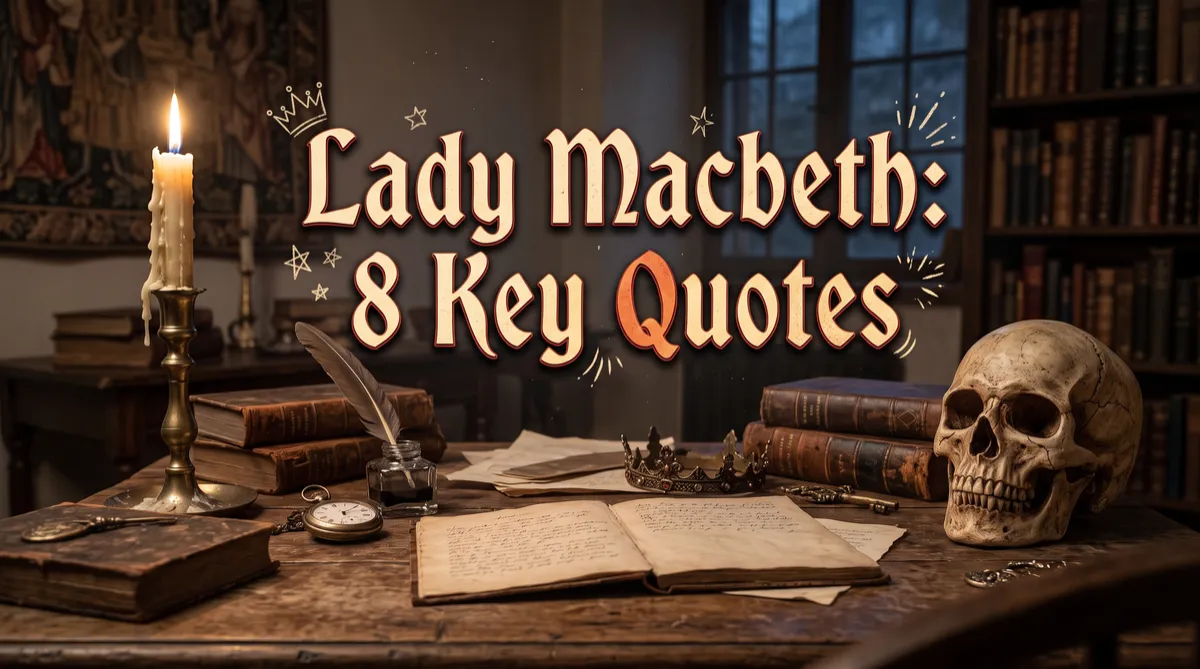
Lady Macbeth Key Quotes: 8 Must-Know Quotes for Your GCSE Mocks

With mocks only a few weeks away, many Year 11s are opening their copy of Macbeth and wondering where to start. If Macbeth is your Shakespeare text, Lady Macbeth is one of the characters you simply have to know well. She drives the first half of the play, then almost disappears, then returns in one of the most famous scenes Shakespeare ever wrote.
The good news is that you don't need fifty quotes to write confidently about her. You need a small set of short, flexible quotations that cover her whole journey, and you need to know what each one does. Here are the eight I'd teach any student before a mock.
Why Lady Macbeth matters in your mock
Examiners love characters who change, and Lady Macbeth changes more dramatically than almost anyone in the play. In Act 1 she is commanding and certain; by Act 5 she is sleepwalking and haunted by guilt. That arc gives you a ready-made essay structure, and it lets you write about big themes such as ambition, gender, guilt and the supernatural.
It also links neatly to context. A Jacobean audience would have expected a wife to be obedient and gentle, so a woman who calls on evil spirits and mocks her husband's courage would have been deeply unsettling.
The 8 key quotes, act by act
1. "Come, you spirits / That tend on mortal thoughts, unsex me here" (Act 1, Scene 5)
She asks to be stripped of her femininity so that nothing gentle can stop her. The imperative "Come" shows her taking control, and calling on spirits links her to the witches and the supernatural.
2. "Look like th' innocent flower, / But be the serpent under 't" (Act 1, Scene 5)
Her advice to Macbeth is all about deception. The serpent recalls the Garden of Eden, presenting her as a tempter who leads her husband into sin.
3. "When you durst do it, then you were a man" (Act 1, Scene 7)
She attacks Macbeth's masculinity to push him into murder. This is manipulation through shame, and it shows how she links being a man with violence.
4. "Infirm of purpose! / Give me the daggers" (Act 2, Scene 2)
When Macbeth panics after the murder, she takes charge. The exclamation and the blunt command show her control is at its height.
5. "A little water clears us of this deed" (Act 2, Scene 2)
She dismisses the murder as something easily washed away. Hold on to this one: it becomes deeply ironic in Act 5.
6. "Nought's had, all's spent, / Where our desire is got without content" (Act 3, Scene 2)
Now queen, she admits that getting what they wanted has brought no happiness. The rhyming couplet sounds neat, but the meaning is empty: the first crack in her confidence.
7. "Out, damned spot! out, I say!" (Act 5, Scene 1)
Sleepwalking, she tries to scrub away blood that isn't there. The woman who gave orders now gives orders to a stain she cannot remove.
8. "all the perfumes of Arabia will not sweeten this little hand" (Act 5, Scene 1)
Compare this with quote 5. "A little water" has become "all the perfumes of Arabia", and even that is not enough. Her guilt has grown beyond anything she can control.
Track her arc: from control to collapse
Notice how the quotes fall into three stages. In Act 1 she is in control, using commands and manipulation. In Acts 2 and 3 she is cracking, still giving orders but already admitting that power brings no peace. In Act 5 she has collapsed, speaking in broken prose rather than the confident verse she used earlier.
If you can explain that journey in a sentence or two, you have the backbone of an essay. Whatever extract you are given in the mock, ask yourself: where is she on this journey, and how does this moment connect to the rest of the play?
A model paragraph
Here is a short paragraph I wrote to show how to use one quote well. Notice that it zooms in on individual words, links to context and connects to the wider play.
Shakespeare presents Lady Macbeth as a skilled manipulator when she tells her husband to "look like th' innocent flower, / But be the serpent under 't". The contrast between the "flower" and the "serpent" suggests that her evil is hidden beneath an appearance of innocence. The serpent would remind a Jacobean audience of the devil tempting Eve in the Garden of Eden, so Shakespeare positions Lady Macbeth as a tempter who leads her husband away from God. This makes her later collapse even more powerful: the woman who taught Macbeth to hide his guilt is eventually unable to hide her own.
You could use the same structure for any of the eight quotes: point, quote, zoom in on a word, context, then a link across the play.
Three mistakes to avoid
Calling her simply "evil". Show that she is complex. Her guilt in Act 5 suggests she was never as ruthless as she wanted to be.
Retelling the plot. The examiner knows the story. Spend your time on how Shakespeare presents her.
Only writing about Act 1. The best answers show change, so always bring in her later scenes.
Key takeaways
Learn eight short quotes that cover all of her journey, not dozens of long ones.
Group them into three stages: in control, cracking and collapsed.
Pair quotes 5 and 8 to show how her attitude to guilt is reversed.
Zoom in on single words such as "serpent", "unsex" and "spot".
Link to Jacobean ideas about women, the supernatural and sin.
If your child would like some focused help with Macbeth or any other part of GCSE English before the mocks, I'd be happy to talk it through.
You can book a free GCSE consultation here, and we can work out together what would help most.


Empowering students across the United Kingdom to reach their potential

Links
Legal
Newsletter
Join our community to stay updated on the latest courses, exclusive content, and learning resources. Subscribe now and take the next step in your educational journey!


© Copyright 2025. Step Ahead Tuition. All Rights Reserved. Powered by Lead Core.