GCSE English Revision Tips, Exam Guides & Tutoring Blog | Step Ahead
Explore expert GCSE English advice, Grade 9 revision guides, and exam strategies for AQA and other boards. Boost your English Literature and Language grades today.
GCSE English SPaG: 6 Punctuation Tips to Boost Your Writing Mark Before GCSE Mocks


Hi everyone!
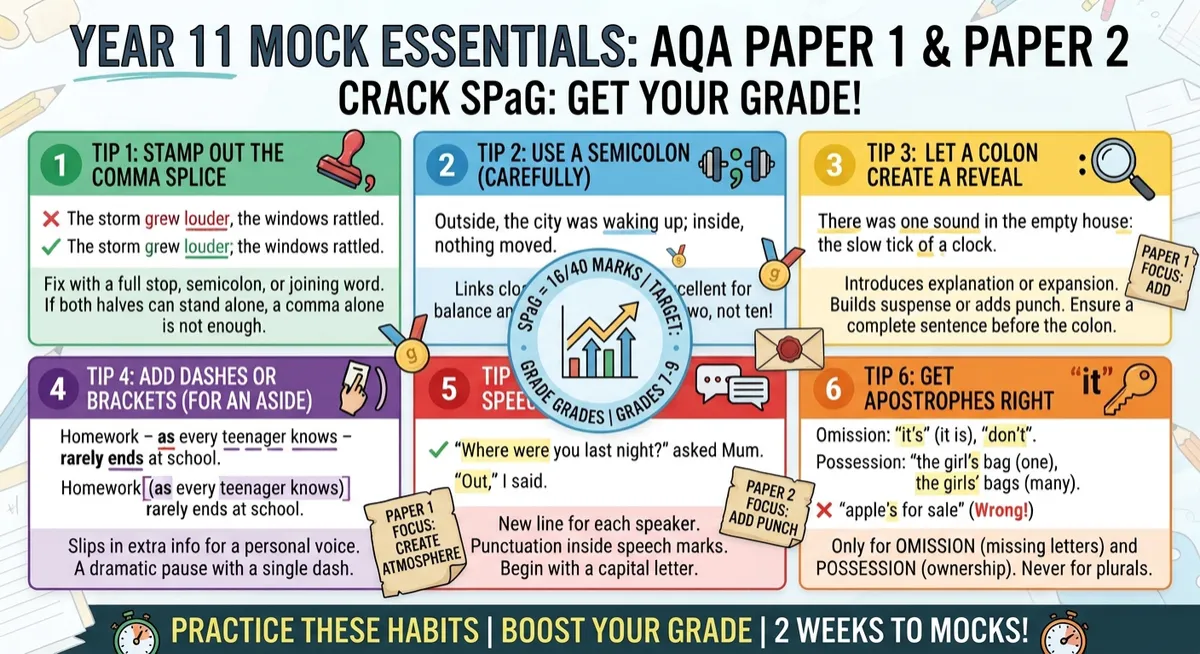
With mocks only weeks away for most Year 11 students, there is one part of the English Language exam where marks can be won back quickly: technical accuracy. On AQA, 16 of the 40 marks on each writing question (Question 5 on both Paper 1 and Paper 2) are for spelling, punctuation, grammar and vocabulary, and the other exam boards give it a similar weight. That is a big slice of the grade, and a lot of it comes down to a handful of habits you can practise this half term.
Here are six punctuation tips I share with my own students, with examples you can borrow for your practice.
Why SPaG matters more than you think
Examiners are not looking for perfection. They are looking for control and range. A student who only ever uses full stops and commas, even correctly, limits how high they can climb. A student who scatters semicolons everywhere but uses them wrongly loses marks in a different way. The goal is varied punctuation, used accurately and on purpose.
Tip 1: Stamp out the comma splice
This is the single most common error I see in mock papers: two complete sentences joined by a comma.
✗ The storm grew louder, the windows rattled in their frames.
You can fix it with a full stop, a semicolon or a joining word such as and, as or until:
✓ The storm grew louder; the windows rattled in their frames.
Quick check: if both halves could stand alone as sentences, a comma on its own is not enough.
Tip 2: Use a semicolon to link closely related ideas
A semicolon joins two complete sentences that belong together. It is especially effective for balance and contrast:
Outside, the city was waking up; inside, nothing moved.
Use one or two in an answer, not ten. Like any special effect, it loses its power if you overuse it.
Tip 3: Let a colon create a reveal
A colon introduces something that explains or expands on what came before. In descriptive writing it builds suspense; in persuasive writing it adds punch.
There was only one sound in the empty house: the slow tick of a clock.
The solution is simple: give young people somewhere to go.
Quick check: the part before the colon should make sense as a complete sentence.
Tip 4: Add dashes or brackets for an aside
A pair of dashes or brackets lets you slip in extra information or a comment, which is perfect for creating a personal voice in a Paper 2 article or speech.
Homework – as every teenager knows – rarely ends at the school gate.
A single dash near the end of a sentence creates a dramatic pause:
She opened the door and froze – the room was empty.
Tip 5: Punctuate speech correctly (and keep it short)
Speech is where careful writers often lose easy marks. Remember three rules:
Start a new line for each new speaker.
Put the punctuation that ends the speech inside the speech marks.
Begin the spoken words with a capital letter.
"Where were you last night?" asked Mum, without looking up.
"Out," I said.
In creative writing, a few lines of well-punctuated dialogue are worth far more than a page of chatter.
Tip 6: Get apostrophes right every time
Apostrophes have just two jobs:
Omission – showing letters are missing: it's (it is), don't, they're.
Possession – showing ownership: the girl's bag (one girl), the girls' bags (more than one).
They never make an ordinary plural, so "apple's for sale" is always wrong. And remember that its (belonging to it) has no apostrophe:
It's clear that the school's policy has lost its way.
Putting it together: a model paragraph
Here is a short descriptive paragraph I wrote to show how a range of punctuation can sit naturally in your writing:
The station was almost deserted. A single train waited at the far platform; its engine hummed like a tired animal. Only one passenger remained on the bench: an old man in a grey coat, clutching a battered suitcase. He checked his watch – again – and sighed. "Not long now," he murmured to no one at all.
Notice the short opening sentence, the semicolon linking two related ideas, the colon revealing the passenger, the paired dashes adding a weary aside, and correctly punctuated speech to finish. Nothing feels forced, and every choice adds to the mood.
How to practise before your mocks
Save five minutes to proofread. Read each sentence slowly and hunt for comma splices first.
Keep a punctuation toolkit. Aim to use three or four different types accurately in every writing answer.
Upgrade an old answer. Take a practice piece you have already written and improve the punctuation only. It is a quick, focused task that builds the habit.
Parents, ask "why?" If your child uses a semicolon or colon, ask them to explain the choice. Being able to explain it shows real understanding.
Key takeaways
Technical accuracy is a big share of the writing marks, so small fixes add up.
Never join two complete sentences with just a comma.
Semicolons link related ideas; colons introduce a reveal or explanation.
Dashes and brackets add an aside and a personal voice.
Speech and apostrophes follow simple rules, so learn them once and use them every time.
Aim for range and accuracy, then proofread.
Want some help before the mocks?
If your child knows what they want to say but keeps losing marks on the details, a few focused sessions can make a real difference. At Step Ahead Tutoring, I teach online GCSE English lessons on Google Meet, in small groups of up to six or one to one, for AQA, Edexcel, OCR and Eduqas students.
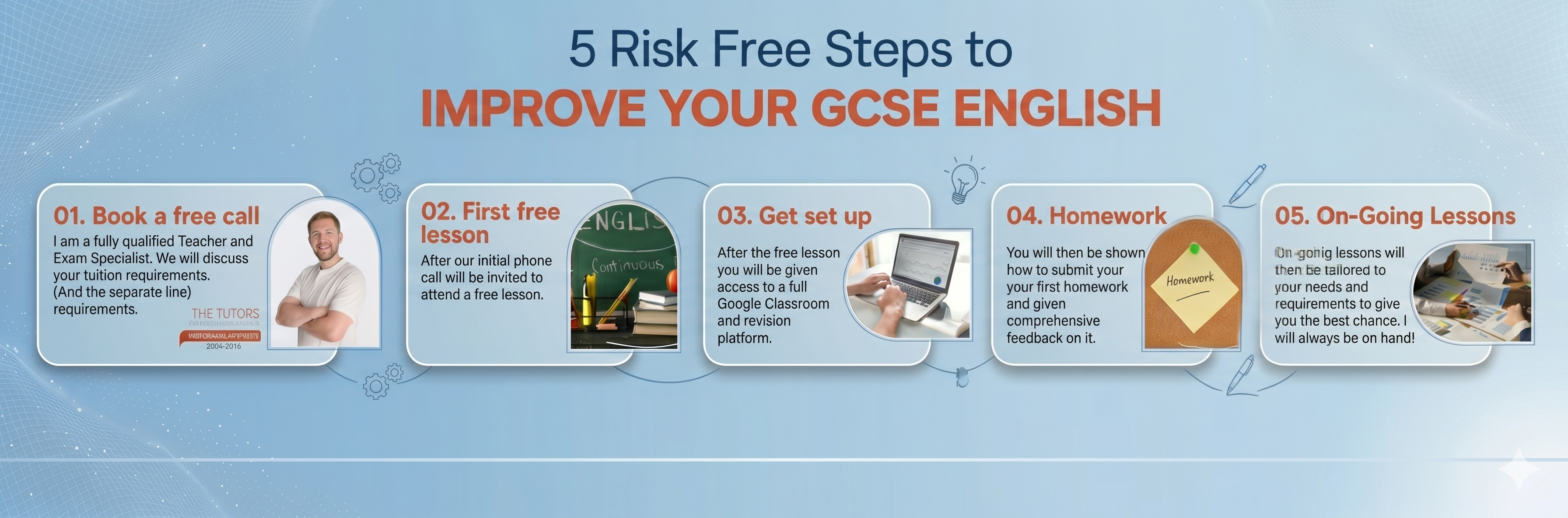
Book a free GCSE consultation and we can talk through where your child is now and what will help most.


Empowering students across the United Kingdom to reach their potential
Links
Legal
Newsletter
Join our community to stay updated on the latest courses, exclusive content, and learning resources. Subscribe now and take the next step in your educational journey!


© Copyright 2025. Step Ahead Tuition. All Rights Reserved. Powered by Lead Core.