GCSE English Revision Tips, Exam Guides & Tutoring Blog | Step Ahead
Explore expert GCSE English advice, Grade 9 revision guides, and exam strategies for AQA and other boards. Boost your English Literature and Language grades today.
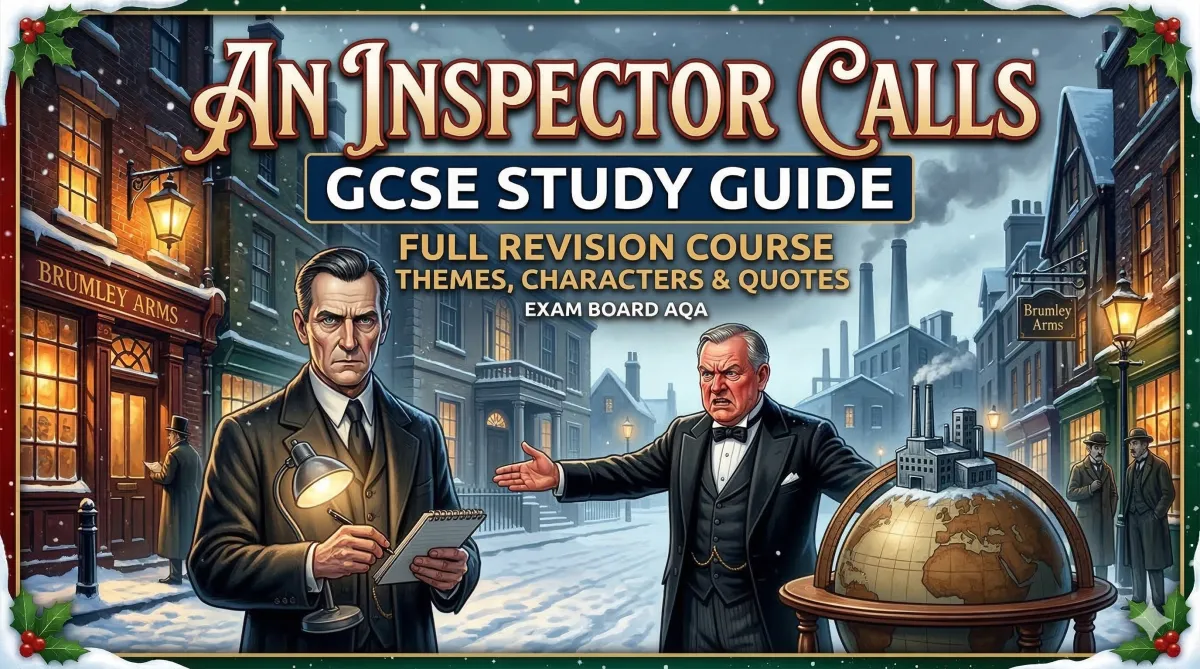
An Inspector Calls Mock Essay: How to Plan and Write a Top-Grade Answer in 45 Minutes

Mock season is almost here, and for many Year 11 students An Inspector Calls is the question where marks quietly slip away. It is rarely because they do not know the play. More often they start writing without a plan, spend twenty minutes on one paragraph, and run out of time before the conclusion. The good news is that a timed essay is a skill, and skills can be practised. Here is the routine I teach my students for AQA Paper 2, Section A, where you have roughly 45 minutes.
Know what the examiner is rewarding
The question is worth 34 marks: 12 for your ideas and quotations (AO1), 12 for how Priestley uses language, structure and form (AO2), 6 for context (AO3) and 4 for spelling, punctuation and grammar. That means half the marks are about methods, so a plan that only lists characters and events will never reach the top bands. (Other exam boards weight things differently, so always check your own specification.)
Spend five minutes planning
Take a typical question: How does Priestley present responsibility in An Inspector Calls? Do not start with a list of characters. Start with an argument, then choose three points that prove it. A simple box plan is enough:
Paragraph 1, Mr Birling: selfish individualism. Quotation: "community and all that nonsense" (Act One). Context: confident 1912 predictions that the audience in 1945 knows are wrong.
Paragraph 2, the Inspector: collective responsibility. Quotation: "members of one body" (Act Three). Method: the Inspector's final speech as a warning to the audience.
Paragraph 3, Sheila: change is possible. Quotation of your choice from Sheila's reaction. Method: the younger generation as Priestley's hope.
One quotation, one method and one context point per paragraph is plenty. Short, precise evidence beats long quotations every time.
Open with a line of argument
Your first sentence should answer the question, not retell the plot. For example: "Priestley presents responsibility as something society cannot opt out of, using the Birlings' complacency to warn a post-war audience about the dangers of selfish capitalism." Notice that it names the play's purpose, the time it was written (1945) and the time it is set (1912) without a single line of summary.
Write a model paragraph
Here is a paragraph I wrote to show how the pieces fit together:
Priestley uses Mr Birling to show how selfishness hides behind confidence. His dismissal of "community and all that nonsense" in Act One is strikingly casual: the word "nonsense" reduces shared duty to something foolish, and his dismissive tone makes him sound pompous rather than wise. Because the play is set in 1912, the 1945 audience knows that his confident predictions, such as the "unsinkable" Titanic, will be proved wrong, so Priestley uses dramatic irony to suggest that those who reject responsibility are mistaken about far more than business.
Look at what it does. The first sentence makes a point, the quotation is short and embedded, a single word is analysed, the context is woven into the argument rather than bolted on at the end, and the final clause links back to the question.
Write to the clock
Here is a timetable that works for most students:
5 minutes: plan.
3 minutes: introduction with a clear argument.
30 minutes: three body paragraphs, about 10 minutes each.
3 minutes: a short conclusion that links to the Inspector's warning, "fire and blood and anguish" (Act Three).
4 minutes: check your work.
Practise with a timer at home. If a paragraph is running long, finish the sentence and move on; a complete essay with three good paragraphs scores more than a brilliant first paragraph and nothing else.
Use your last four minutes well
Those four marks for spelling, punctuation and grammar are easy to protect. Check capital letters on character names, apostrophes, and the spelling of words you use constantly: Priestley, responsibility, audience, Eva Smith. Read your final sentence aloud in your head to make sure it makes sense.
Key takeaways
Half of the marks reward methods, so plan for language, structure and form, not just events.
Spend five minutes on a box plan with three paragraphs that prove one argument.
Use one short quotation, one method and one context point in each paragraph.
Give each body paragraph about 10 minutes and practise with a timer.
Keep four minutes at the end to check spelling, punctuation and grammar.
Want help turning this into a habit?
Timed essays feel much less stressful once the routine is automatic.
If you would like personalised feedback on your An Inspector Calls essays before the mocks, you are welcome to book a free GCSE consultation and we can talk through what would help most.


Empowering students across the United Kingdom to reach their potential

Links
Legal
Newsletter
Join our community to stay updated on the latest courses, exclusive content, and learning resources. Subscribe now and take the next step in your educational journey!


© Copyright 2026. Step Ahead Tuition. All Rights Reserved. Powered by Lead Core.