GCSE English Revision Tips, Exam Guides & Tutoring Blog | Step Ahead
Explore expert GCSE English advice, Grade 9 revision guides, and exam strategies for AQA and other boards. Boost your English Literature and Language grades today.
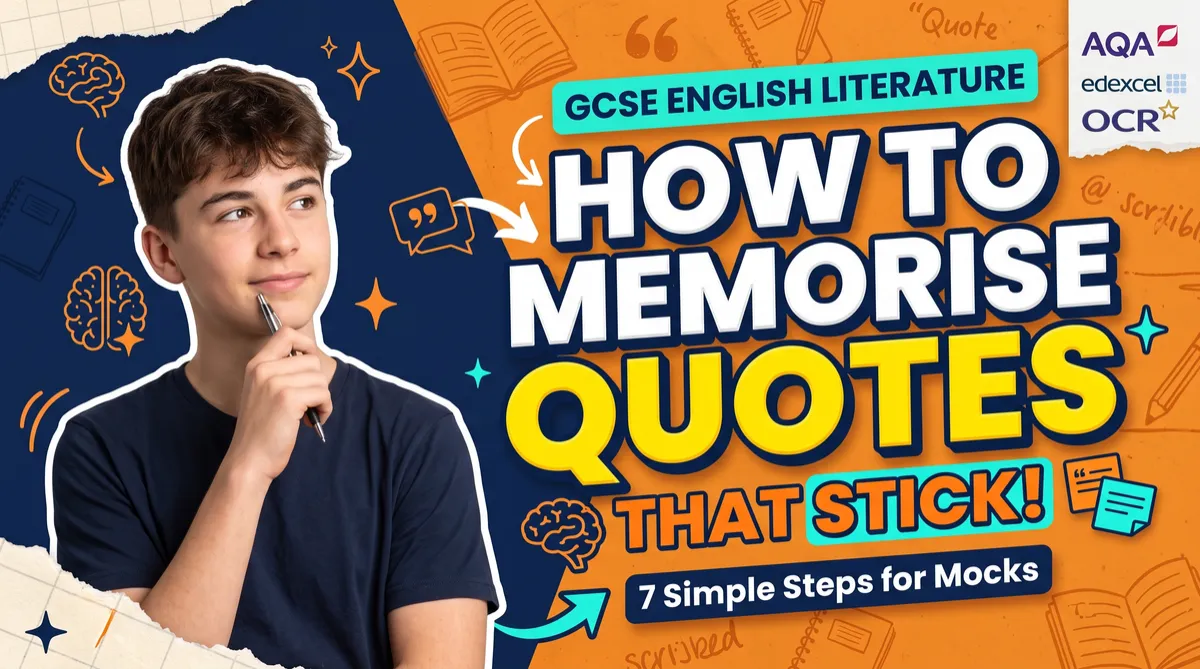
How to Memorise Quotes for GCSE English Literature: 7 Methods That Work Before Mocks

“I understand the play, I just can’t remember the quotes.” I hear this from Year 10 and 11 students every October. With mocks approaching and every GCSE English Literature exam (AQA, Edexcel, OCR and Eduqas) being closed book, quotations can feel like the biggest mountain to climb.
The good news? Memorising quotes isn’t a talent some people are born with. It’s a skill. Here’s how to memorise quotes for GCSE English Literature so they stick – and so you can use them in the exam.
1. Learn fewer quotes, but better ones
Students often try to learn 40 quotes per text and remember none under pressure. Aim for around 10–15 short, flexible quotes per text instead. A flexible quote is one you can use for several characters or themes.
For example, in Macbeth, the witches’ line “Fair is foul, and foul is fair” (Act 1, Scene 1) works for essays on the supernatural, deception, appearance versus reality, and even Macbeth himself. One quote, four essays.
2. Shrink long quotes down to the words that matter
Examiners reward what you do with a quotation, not its length. So cut each quote down to its most powerful few words.
In Jekyll and Hyde, the narrator describes Hyde attacking Sir Danvers Carew “with ape-like fury” (Chapter 4, “The Carew Murder Case”). You don’t need the whole sentence – “ape-like fury” is the bit you’ll analyse, because it links Hyde to Victorian fears about evolution and humans slipping back into something animal.
3. Test yourself – don’t just reread
Rereading feels productive, but familiarity isn’t memory. What builds memory is retrieval practice: trying to pull the quote out of your head before you check it.
Try these:
Flip the flashcard. Put the character or theme on the front (e.g. “Lady Macbeth – deception”) and the quote on the back. Say the quote aloud before you turn the card over.
Blank-page recall. Write a character’s name in the middle of a page and see how many quotes you can remember in five minutes. Then check and fill the gaps in a different colour.
4. Space it out over days, not hours
Cramming the night before a mock works for about a day. To make quotes last until the summer, review them on a spaced schedule: learn a quote on Day 1, test it again on Day 3, then Day 7, then Day 14.
A simple way to do this is with three envelopes or piles of flashcards: “Don’t know” (test daily), “Nearly there” (every few days) and “Got it” (once a week). Cards move up when you get them right and drop back down when you don’t. Ten minutes a day is plenty.
5. Attach every quote to an idea
A quote you can recite but can’t explain won’t earn many marks. On the back of each flashcard, add three things: the key word to zoom in on, the idea it shows, and one link to context or the writer’s purpose.
Here’s how that looks in a paragraph, using Lady Macbeth’s advice to her husband to “look like th’ innocent flower, / But be the serpent under’t” (Act 1, Scene 5):
Shakespeare presents Lady Macbeth as a master of deception when she tells Macbeth to “look like th’ innocent flower, / But be the serpent under’t”. The contrast between the delicate “flower” and the hidden “serpent” suggests that evil is most dangerous when it hides behind a harmless surface. The serpent also echoes the serpent that tempts Eve in the Garden of Eden, so a Jacobean audience would see Lady Macbeth as tempting her husband towards sin and damnation.
Notice that the quote is short, embedded in the sentence, and followed by analysis of individual words. That’s what you’re aiming for.
6. Make your quotes impossible to avoid
Stick quotes on sticky notes around your mirror or the fridge. Record yourself reading them and listen on the walk to school. Teach a quote and its meaning to someone at home – explaining it aloud quickly shows whether you really understand it.
Parents, this is a lovely, low-pressure way to help. You don’t need to know the text: just read the theme on a flashcard and ask your child for the quote and what it shows.
7. Practise using quotes under time pressure
Remembering a quote at your desk is different from remembering it mid-exam. Once a week, set a timer for 15 minutes and write a single paragraph on a practice question using one of your learned quotes. If a quote won’t come to mind in timed conditions, it goes back into the “Don’t know” pile.
If you go blank in the exam, don’t panic: refer closely to the moment instead (e.g. “when Scrooge is compared to an oyster in Stave 1”). Close reference still earns credit.
Key takeaways
Learn 10–15 short, flexible quotes per text rather than dozens of long ones.
Cut every quote down to the few words you’ll actually analyse.
Test yourself with flashcards and blank-page recall instead of rereading.
Review quotes on Day 1, 3, 7 and 14 to make them stick until the summer.
Attach each quote to a key word, an idea and a piece of context.
Practise writing timed paragraphs so you can use quotes under pressure.
Want some help getting mock-ready?
If your child knows their texts but struggles to use quotations under exam conditions, structured support can make a real difference. At Step Ahead Tutoring, I help GCSE students build revision routines that work, in small groups or 1:1 online lessons.
Book a free GCSE consultation and we can talk through where your child is now and what would help most before their mocks.


Empowering students across the United Kingdom to reach their potential

Links
Legal
Newsletter
Join our community to stay updated on the latest courses, exclusive content, and learning resources. Subscribe now and take the next step in your educational journey!


© Copyright 2025. Step Ahead Tuition. All Rights Reserved. Powered by Lead Core.