GCSE English Revision Tips, Exam Guides & Tutoring Blog | Step Ahead
Explore expert GCSE English advice, Grade 9 revision guides, and exam strategies for AQA and other boards. Boost your English Literature and Language grades today.

Master Analytical Writing: Beyond PEEL for GCSE Success
GCSE English, Analytical Writing, PEEL Method

Beyond PEEL: How to Weave Seamless Analytical Paragraphs
If you have ever stared at an exam question thinking, “I know what I want to say, but I don’t know how to say it,” this guide is for you. At Step Ahead English Tuition, we specialise in helping GCSE students turn scattered ideas into clear, confident analytical writing – the kind that examiners love and that leads to high-scoring essays.
Why Analytical Writing Matters So Much at GCSE
Analytical writing is at the heart of GCSE English. Whether you are exploring a poem, analysing a character in a novel, or evaluating a non-fiction text, the exam is really asking one big question: Can you explain how and why the writer creates meaning?
Many students know key quotes and techniques, but lose marks because their paragraphs feel bitty, repetitive, or unfinished. They might have a good point, but it is not developed into a seamless argument. The examiner can see the potential, but the analysis never quite joins up into a convincing whole. That is exactly what we want to fix here.
💡 Quick insight: Examiners reward clear thinking on the page. Strong analytical paragraphs show a logical, flowing thought process – not just a list of techniques.
The PEEL Method: Helpful, But Only a Starting Point
You have probably been taught the PEEL method:
Point – make a clear point that answers the question.
Evidence – choose a relevant quote or example from the text.
Explain – explore how the evidence supports your point.
Link – connect back to the question or move to your next idea.
PEEL is a brilliant scaffold, especially in Years 8–10. It reminds you not to forget your quote or your explanation. But by GCSE, especially if you are aiming for grades 7–9, PEEL on its own can start to feel a bit mechanical. Paragraphs can sound like a checklist instead of a natural, thoughtful response. That is where going beyond PEEL makes a real difference.
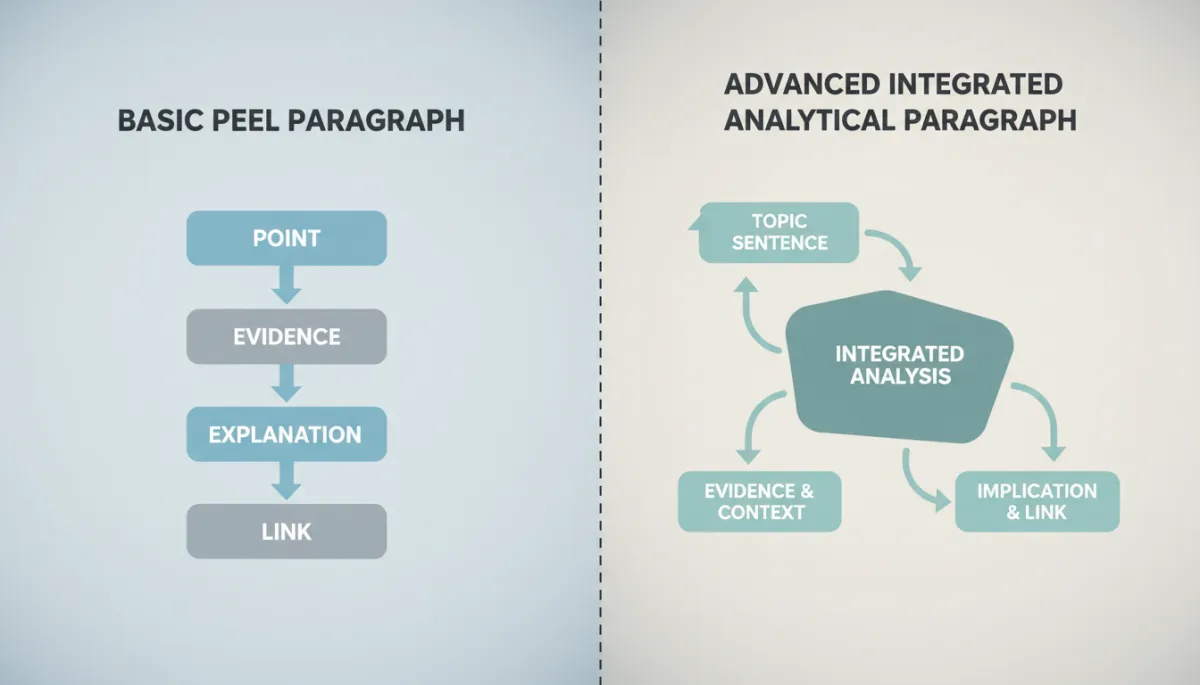
Moving beyond basic PEEL helps your analysis sound mature, fluent, and examiner-ready.
From Formula to Flow: What Makes a Paragraph Seamless?
A seamless analytical paragraph feels like one continuous line of thought. Instead of jumping from point to quote to explanation in separate blocks, everything is integrated. Your point grows naturally out of the question, your evidence is woven smoothly into the sentence, and your explanation digs deeper rather than stopping after one idea. This is what we call integrated analysis.
Think of PEEL as the skeleton. To get high-scoring essays, you need to add muscles, movement, and personality. That means:
Blending your point and evidence into one fluent sentence where possible.
Explaining not just what a technique does, but why it matters and how it affects the reader.
Making mini-connections to context, themes, or the writer’s intentions within the same paragraph.
💡 Exam tip from Step Ahead English Tuition: If your paragraph can be chopped into four separate sentences labelled P, E, E, and L, it is probably too basic. Aim for sentences that do more than one job at once.
A Quick Before-and-After: Transforming a PEEL Paragraph
Let’s take a simple example from a typical GCSE text. Imagine the question is: How does the writer present the character’s loneliness?
Basic PEEL Paragraph
The writer presents the character as lonely. “He walked home alone in the dark.” This shows he is lonely because he has no one to walk with. The word “alone” shows he is by himself. This links to the question because it shows he is lonely.
Improved, Seamless Analytical Paragraph
The writer presents the character’s loneliness as inescapable, surrounding him even in everyday moments. When we are told that “he walked home alone in the dark”, the adverb “alone” emphasises his physical isolation, while “in the dark” suggests an emotional darkness too. By combining the setting with his solitude, the writer implies that loneliness has become a normal part of his routine, encouraging the reader to feel sympathy for how cut off he is from other people.
Notice how the second version still has a point, evidence, explanation, and a link back to the question – but the writing techniques are used more thoughtfully, and the analysis is integrated into a smooth argument rather than broken into chunks.
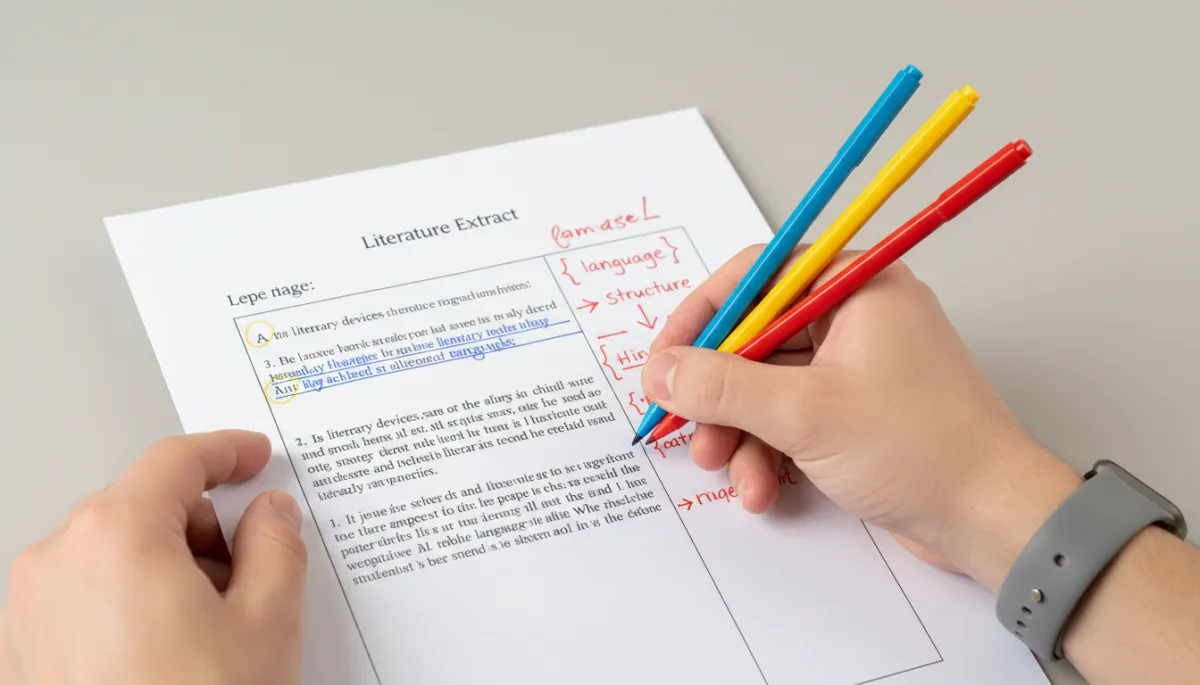
Detailed annotations make it easier to build layered, insightful explanations under time pressure.
Building Integrated Analysis: Step-by-Step
1. Start with a Clear, Focused Idea – Not Just a Topic
Instead of beginning with “The writer uses language to show…”, try to capture something specific and insightful. For example:
Weak: The writer presents the character as sad.
Stronger: The writer presents the character’s sadness as something he hides from others.
That small shift instantly gives your paragraph direction and makes your argument more interesting to read – and to mark.
2. Embed Your Evidence Smoothly
Instead of dropping a quote on its own line, weave it into your sentence. For example:
Clunky: The writer shows this when he says, “He walked home alone in the dark.”
Smoother: This is suggested when he “walked home alone in the dark”.
Embedded quotes help your paragraph feel more mature and controlled, and they support seamless arguments because the evidence becomes part of your thinking, not an interruption.
3. Zoom In on Specific Words and Techniques
High-scoring essays do not just label a technique and move on. They zoom in on how it works. Instead of writing, “This is a metaphor which shows…”, try:
Focusing on a single word or phrase: The adjective “dark” suggests…
Exploring layers of meaning: On one level this implies… but it might also suggest…
This kind of detailed, integrated analysis shows the examiner you are thinking carefully about the writer’s choices, not just spotting techniques for the sake of it.
4. Push Your Explanation One Step Further
Once you have explained what a quote suggests, ask yourself: So what? Why would the writer want us to feel or think this way? How does it link to a bigger idea in the text, such as power, conflict, or identity? Adding that extra step is often what lifts a paragraph from a grade 5 or 6 into the 7–9 range.
💡 Try this mini-check: After each explanation, add a sentence starting with “This matters because…”. If you cannot complete that sentence, your analysis might still be too shallow.
Linking Ideas: Creating Seamless Arguments Across a Whole Essay
Seamless analytical paragraphs do not just work on their own – they also link together to form a convincing whole argument. That is crucial for high-scoring essays, especially in longer literature questions where you are expected to develop a line of reasoning across several paragraphs.
You can create this sense of flow by:
Using linking phrases that build on what you have just said: Furthermore,In contrast,Similarly,However,On the other hand,.
Referring back to key words from the question to keep your focus sharp.
Showing how different points relate to each other – for example, how a character changes, or how one scene echoes another.
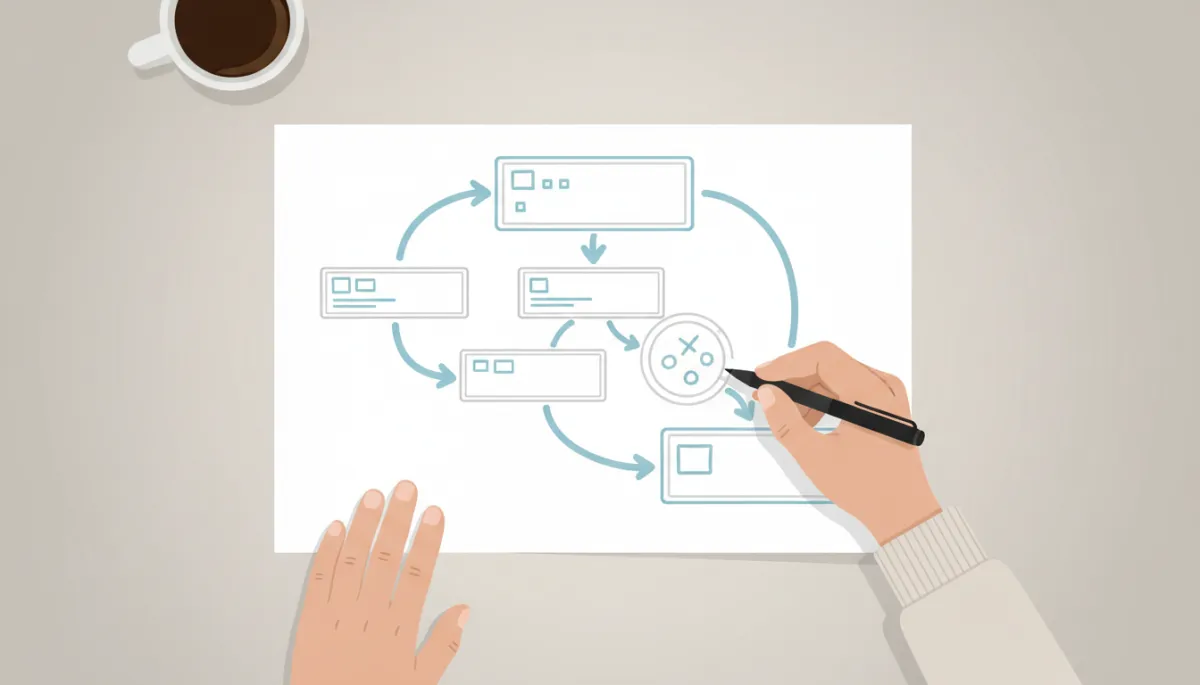
A simple flow plan can help you see how each paragraph pushes your argument forward.
Practical Writing Techniques to Use in the Exam Hall
It is one thing to understand integrated analysis when you are calm at home; it is another to do it under timed conditions. Here are some exam-friendly writing techniques that our Step Ahead English Tuition students find especially helpful when the clock is ticking.
1. The 3-Sentence Paragraph Starter
When you are under pressure, use this simple pattern to get going, then add detail:
Sentence 1 – Argument: Directly answer a small part of the question with a clear idea.
Sentence 2 – Evidence: Embed a short, precise quote that supports your idea.
Sentence 3 – Effect: Explain the effect on the reader or what it reveals about a character or theme.
Once those three are on the page, you can add extra explanation, comparisons, or context to deepen your integrated analysis.
2. The “Because, So, However” Trick
If you find your analysis stopping too soon, try finishing your explanation with one of these words:
Because… encourages you to explain the writer’s intention.
So… pushes you to think about the impact on the reader.
However… invites you to consider a different interpretation, which examiners love.
These tiny words are powerful writing techniques for turning a basic explanation into a more complex, thoughtful response that feels like a seamless argument rather than a simple statement.
3. Mini-Comparisons Within a Paragraph
For comparison questions (especially in poetry), you can create high-level integrated analysis by comparing within a single paragraph. For example:
While Poet A presents power as violent and uncontrollable, Poet B suggests it is more subtle and psychological…
This shows the examiner you are thinking across texts, not just writing two separate mini-essays. It is a hallmark of high-scoring essays.
Common Pitfalls – And How to Fix Them Fast
1. Technique-Spotting Without Real Analysis
Writing “This is a simile which shows…” is not enough. Examiners are not giving marks for recognising a metaphor; they reward you for explaining what that metaphor adds to the text. Always follow up with the effect: What does it make us imagine, feel, or understand differently?
2. Repeating the Question Instead of Developing Ideas
Many students keep repeating phrases from the question, thinking it will impress the examiner. It is good to echo key words, but you also need to push your thinking forward. Instead of “This shows he is lonely”, try “This suggests his loneliness has become normal to him, which makes it more tragic.”
3. Ending Paragraphs Abruptly
If your last sentence is “This links to the question because…”, you are probably cutting yourself off too early. Instead, try ending with a sentence that pulls together your ideas and looks outward to the bigger picture of the text or theme. For example: Overall, the writer suggests that loneliness is not just a momentary feeling but a state that shapes how the character sees the world.

Using feedback to spot patterns in your writing can rapidly improve paragraph quality.
How Step Ahead English Tuition Can Help You Go Beyond PEEL – Fast
You do not need months of extra work to improve your analytical writing. With the right guidance and a few focused strategies, you can transform your paragraphs in a matter of hours. That is exactly what we focus on at Step Ahead English Tuition: fast, targeted support that turns confusing advice into clear, practical steps you can use in your next mock or real exam.
Our revision resources and personalised study plans are designed specifically for GCSE students who want to:
Move from basic PEEL paragraphs to confident, integrated analysis.
Build seamless arguments that stay tightly focused on the question.
Turn teacher feedback like “explain more” or “develop this” into clear actions.
💡 Good to know: Our examiner-approved paragraph templates are flexible, not rigid. They help you remember what to include while still sounding natural and individual – perfect for high-scoring essays.
Bringing It All Together: Your Next Steps
Going beyond PEEL is not about throwing away everything you have learned. It is about upgrading your approach so your analytical writing feels fluent, thoughtful, and exam-ready. By focusing on integrated analysis, embedding evidence smoothly, zooming in on key words, and always asking “So what?”, you can turn solid paragraphs into seamless arguments that stand out to examiners.
The best part? These skills are completely learnable. With a bit of practice – and the right support – you will start to notice your confidence growing every time you tackle a literature or language question. Instead of dreading “Explain how the writer…”, you will have a clear plan for building high-scoring essays, one strong paragraph at a time.
If you are ready to make that jump now, Step Ahead English Tuition is here to help you do it quickly and effectively. Our personalised revision packages are designed to fit around your schedule, even if the exam date is getting close. You will get practical writing techniques, model paragraphs, and tailored feedback that show you exactly how to improve – not in weeks, but in hours.
Start improving today by choosing a personalised revision package and get instant access to fast, proven GCSE English support. With the right tools and guidance, you can move beyond basic PEEL and start writing the seamless, analytical paragraphs that your examiners – and your future self – will thank you for.


Empowering students across the United Kingdom to reach their potential

Links
Legal
Newsletter
Join our community to stay updated on the latest courses, exclusive content, and learning resources. Subscribe now and take the next step in your educational journey!


© Copyright 2025. Step Ahead Tuition. All Rights Reserved. Powered by Lead Core.